
Table of Contents
Laser focus isn’t magic, it’s trainable. I’ll show you 5 proven ways to eliminate distraction, concentrate deeply, and build real focus that lasts.
My Battle With Distraction.
Laser focus used to feel impossible for me. I’d sit down to work, and within five minutes, my phone would buzz. My mind would wander. I’d check social media “just for a second” and lose thirty minutes.
Sound familiar?
Here’s what changed everything for me: I learned that laser focus isn’t something you’re born with. It’s a skill you can train, just like learning to play guitar or getting better at math.
I’m not going to give you generic advice like “just try harder” or “be more disciplined.” Instead, I’ll share five methods backed by real science that helped me go from constantly distracted to genuinely focused. These techniques transformed how I work, study, and think.
Let me show you what actually works.
Why I Couldn’t Focus (And Why You Probably Can’t Either).

My Brain Was Working Against Me.
I used to believe that I was simply indolent or lacking self control. Turns out, my brain was doing exactly what it’s designed to do.
Our brains can only focus on about four things at once. When I tried to juggle my homework, check messages, listen to music, and watch videos simultaneously, my brain was constantly switching between tasks. Each switch made me slower and more tired.
Scientists call this “cognitive load,” and I was massively overloading mine every single day.
How My Phone Destroyed My Laser Focus.
My smartphone was my biggest problem. Every notification gave my brain a tiny hit of dopamine, the same chemical that makes us feel good when we eat chocolate or play video games.
My brain got addicted to those little hits. Research shows that after just 20 minutes of interrupted work, people get more stressed and less focused. That was me every day.
Social media apps are literally designed by engineers to grab your attention and never let go. When I learned this, I realized my focus problems weren’t my fault, I was fighting technology built to distract me.
The Real Cost of Distraction.
Here’s what shocked me: researchers found that after an interruption, it takes 23 minutes to get back to full focus. Twenty three minutes!
Every time I checked my phone during homework, I wasn’t just losing those 30 seconds. I was losing the next 23 minutes of productive work too.
By the end of each day, I was exhausted but had barely finished anything important. That’s when I knew I had to change.
Method 1: How I Used Focus Sprints to Build Laser Focus.

Why Short Work Sessions Changed Everything.
I used to think I needed to work for hours without stopping to prove I was serious. That never worked.
Then I discovered that my brain naturally goes through energy cycles. It can focus intensely for about 25 to 50 minutes, then it needs a break. Fighting this pattern was making me miserable and unproductive.
When I started working with my brain instead of against it, everything changed.
Also read “Active Recovery Workout: 7 Strategic Ways to Reset Fatigue”.
My Focus Sprint System.
Here’s what I do now, and it’s incredibly simple:
I set a timer for 25 minutes. During those 25 minutes, I work on ONE task only. No phone, no social media, no switching to something else. Just that one thing.
I take a five minute rest when the timer goes off. I stand up, walk around, look out the window, anything except staring at a screen.
After four of these sprints, I take a longer 15 to 30 minute break.
This system gave me laser focus because it made focusing feel achievable. Twenty five minutes isn’t scary. I can do anything for 25 minutes.
Mistakes I Made With Focus Timers.
At first, I tried cramming as many tasks as possible into each sprint. That defeated the purpose entirely.
Focus sprints aren’t about speed. They’re about depth. I use them only for work that actually requires laser focus, writing essays, solving math problems, reading difficult material, or learning new skills.
I also used to skip breaks or spend them scrolling through my phone. That destroyed the whole benefit. Your brain needs real rest to maintain laser focus across multiple sessions.
Method 2: How Mindfulness Trained My Laser Focus.

When I Realized Focus Was a Trainable Skill.
This blew my mind: scientists studying people who meditate found that their brains physically change. The parts responsible for attention control actually get bigger with practice.
This meant my laser focus wasn’t permanently broken. I just hadn’t trained it yet.
Every time I noticed my mind wandering and brought it back to what I was doing, I was strengthening my focus like a muscle. I wasn’t failing, I was training.
The Simple Practice That Improved My Focus.
I started with just five minutes every morning. I’d sit comfortably, close my eyes, and pay attention to my breathing.
My mind would wander constantly at first. That’s normal and expected. When I noticed my thoughts drifting, I’d simply bring my attention back to my breath. No judgment, no frustration, just notice and return.
This simple practice taught me to catch myself getting distracted in real life. Now when I’m working and my mind starts wandering, I notice it quickly and get back on track.
Another technique I use: when a distracting thought pops up during work, I mentally label it, “that’s planning” or “that’s worrying” then let it go. This creates distance from the thought without fighting it, which actually makes it less distracting.
How This Reduced My Mental Chaos.
I used to have constant anxiety that made laser focus impossible. My brain was always scanning for problems instead of concentrating on work.
Mindfulness practice lowered my stress levels noticeably. After a few weeks, I felt calmer and could focus much more easily.
Even just five minutes daily made a real difference. It helped my brain recover faster after intense focus sessions, so I could maintain laser focus for longer periods.
Method 3: How I Designed My Space for Laser Focus.
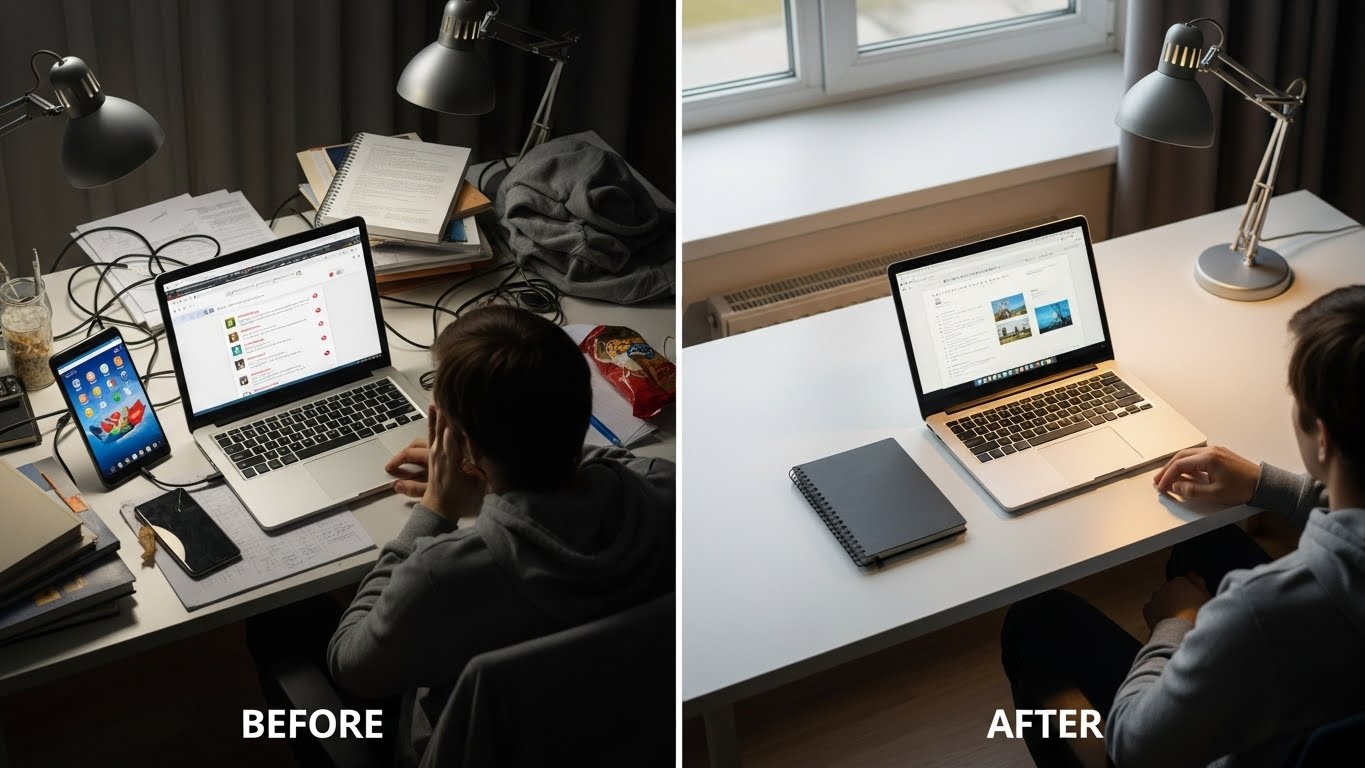
When I Fixed My Messy Workspace.
Princeton researchers proved something I’d experienced: visual clutter steals your focus. When your desk is covered with stuff, your brain is processing all of it constantly, even when you’re trying to ignore it.
I had a messy desk, twenty browser tabs open, and my phone always visible. No wonder I couldn’t achieve laser focus.
I made a simple change: before every focus sprint, I clear my desk of everything except what I need for that specific task. I close all unnecessary programs and tabs. It’s not about being a neat freak, it’s about removing things that compete for my attention.
The difference was immediate and obvious.
What I Did With My Phone.
This was hard but crucial: during focus sprints, my phone goes in another room. Not on my desk face down. Not in my pocket. In another room entirely.
Research shows that just having your phone visible, even turned off reduces your focus. Your brain knows it’s there and uses mental energy to resist checking it.
I also turned off almost all notifications. I don’t need to know instantly about every email, text, or app update. I check messages at specific times instead of letting them interrupt me constantly.
This single change probably doubled my laser focus ability.
How I Made My Space Focus Friendly.
I created a specific workspace that my brain associates with laser focus. For me, it’s a particular corner of my room with good lighting.
Natural light helps a lot. When that’s not available, bright light works better than dim lighting for maintaining focus.
I also experimented with sound. Some people need silence for laser focus, others need background noise. I use instrumental music to block out environmental distractions without grabbing my attention with lyrics.
Find what works for you and then use it consistently.
Method 4: How I Stopped Destroying My Laser Focus With Multitasking.
When I Learned Multitasking Is Fake.
I used to think I was great at multitasking. I’d do homework while watching videos and texting friends.
Turns out, multitasking doesn’t exist for focused work. What I was really doing was rapidly switching between tasks, and it was making me slower and worse at everything.
Stanford researchers found that people who multitask a lot are actually worse at switching tasks than people who focus on one thing at a time. Every switch costs time and mental energy.
When I admitted this and stopped trying to multitask, my laser focus improved dramatically.
My Single Tasking Rule.
Now I follow one simple rule: one task at a time, start to finish, then move to the next.
I also started time blocking. Instead of keeping a vague to do list, I assign specific time blocks to specific tasks. From 3:00 to 4:00 PM, I’m writing my essay. From 4:00 to 4:30 PM, I’m answering messages.
This eliminated the constant decision making about what to work on next. Those small decisions were draining my mental energy all day long.
Time blocking made laser focus easier because I always knew exactly what I should be doing.
How Clear Goals Improved My Focus.
Vague tasks kill laser focus. “Work on project” could mean anything, so my brain never knew when I was done.
Now I define specific outcomes for each focus session. Not “study history” but “read and take notes on chapter 5.” Not “work on presentation” but “finish slides 3 through 7.”
Clear goals give me a target to aim for and a satisfying sense of completion when I finish. This reinforces my focus habits and builds momentum.
Method 5: How My Lifestyle Choices Affected My Laser Focus.

When I Fixed My Sleep Schedule.
I used to stay up late and get about six hours of sleep. I thought I was fine.
Research proved me wrong. Even moderate sleep loss causes serious problems with focus, memory, and impulse control. After two weeks of six hour nights, your brain works like you haven’t slept for 24 hours straight.
Worse, sleep deprivation makes you think you’re doing fine when you’re actually impaired.
When I started getting seven to eight hours consistently, my laser focus improved more than with any technique. Sleep isn’t optional if you want to concentrate well.
How Exercise Sharpened My Mind.
I learned that exercise isn’t just for physical health, it directly improves brain function. It increases blood flow to your brain and promotes growth of new brain cells.
The effects are immediate. A twenty minute walk improves my focus for the next 90 minutes. Regular exercise over weeks and months produces lasting improvements in attention control.
I don’t do anything intense. I just walk for 30 minutes most days. That alone made a noticeable difference in my ability to maintain laser focus.
What I Changed About Eating.
Blood sugar crashes destroy focus. When I ate sugary foods, my energy would spike and crash, taking my concentration with it.
Now I eat balanced meals with protein, healthy fats, and complex carbohydrates. This provides steady energy instead of the rollercoaster I used to experience.
I also keep water nearby during focus sessions. Even mild dehydration impairs attention and thinking. Staying hydrated is simpler than most focus techniques and surprisingly effective.
Mistakes That Killed My Laser Focus Journey.
My biggest mistake was expecting instant results. Building real laser focus took me several weeks of consistent practice. People who quit after a few days never experience the benefits.
I also made the mistake of being inconsistent. Using focus sprints on Monday but abandoning them Tuesday trains nothing. I had to commit to daily practice for at least three weeks before the habits started feeling natural.
Another trap: I spent too much time researching the perfect productivity app and comparing different techniques instead of actually practicing. The tools matter far less than consistent action.
Finally, I used to push for laser focus all day without breaks. That led to burnout. High performance requires recovery time. Now I build in genuine rest periods where I’m not trying to optimize anything.
How I Made Laser Focus Part of Who I Am.
From Techniques to Identity.
The real transformation happened when I stopped thinking “I’m trying to focus better” and started thinking “I’m someone who values laser focus.”
This identity shift made everything sustainable. When focus was just a technique, I’d quit when things got hard. When it became part of who I am, I maintained it automatically.
I started noticing my self talk. Each time I chose focus over distraction, I’d think “I’m the kind of person who puts their phone away during important work.” This gradually became self fulfilling.
My Focus Rituals.
I created a consistent pre work ritual: clear desk, close unnecessary programs, put phone in other room, start timer, begin work.
After repeating this sequence dozens of times, the ritual itself triggers laser focus. This sequence means deep concentration comes next,” my brain concluded.”
Consistency matters more than perfection. When I miss a day, I don’t beat myself up, I just start again immediately instead of waiting for motivation.
How I Track My Progress.
I keep simple records of my focused work time. Just noting how many quality focus sprints I complete daily.
After two weeks, I review the data. Seeing improvement on paper motivates me when progress feels slow day to day.
I celebrate small wins. Completed four uninterrupted sprints? That’s worth acknowledging. Caught myself getting distracted and redirected quickly? That’s evidence my attention control is strengthening.
Progress isn’t linear. Some days I feel scattered despite my best efforts. That’s normal. What matters is consistent practice over weeks and months.
Your Questions About Laser Focus Answered.
What exactly is laser focus?
Laser focus means directing complete attention toward one task while blocking out distractions. It’s deep concentration where you’re fully engaged without your mind wandering. Unlike casual attention, laser focus produces better work and helps you learn faster.
Why can’t I control distractions?
Modern technology exploits how your brain naturally works. Your brain evolved to notice new stimuli because they might signal danger or opportunities. Digital devices trigger these mechanisms constantly. Also, attention control weakens when you’re tired, stressed, or haven’t practiced focusing deliberately.
How long can people maintain laser focus?
Most people can maintain genuine laser focus for 90 to 120 minutes before needing significant rest. Within that time, breaking focus into 25 to 50 minute sprints works better than trying to concentrate continuously. Even top performers typically achieve four to five hours of truly focused work per day, structured in multiple sessions.
Does mindfulness actually help focus?
Yes, proven by extensive brain research. Regular mindfulness practice produces measurable changes in brain regions that control attention. Studies show eight weeks of daily mindfulness practice significantly improves sustained attention and working memory. Benefits appear with as little as 10 minutes of daily practice.
Can multitasking ever work?
For tasks requiring real focus, no. Multitasking is actually rapid task switching, which decreases performance on both tasks. The mental cost of switching exceeds any time saved. However, combining an automatic physical task with mental work (like walking while listening to a podcast) works because the physical task needs minimal attention.
How long until I see improvement?
I noticed initial improvements within one to two weeks. Noticeably stronger attention control developed after three to four weeks. Substantial, lasting changes took two to three months of daily practice. Like physical fitness, attention improvement is gradual and requires ongoing maintenance, but benefits accumulate significantly over time.
Conclusion: My Laser Focus Journey Can Be Yours.
Laser focus isn’t mysterious or rare. It’s a set of learnable skills supported by good habits and smart environmental design.
I’ve shared five methods that transformed my ability to concentrate: focus sprints that work with your brain’s rhythms, mindfulness training that strengthens attention control, environment design that removes distractions, single-tasking that eliminates switching costs, and lifestyle support that maintains your focus capacity.
These aren’t tips to try when you feel motivated. They’re practices to build into your daily life until they become automatic.
Start with one method that resonates most. Commit to it for three weeks. Build it into your routine until it feels natural. Then add another.
The journey from constant distraction to reliable laser focus is available to anyone willing to train their attention deliberately. Your focus isn’t broken, it’s been hijacked by an environment designed to fragment it.
Take it back, one focused sprint at a time.
Tomorrow morning, try a single 25-minute focus session. No phone, no notifications, one task. That’s your first step toward mastering laser focus.
TOP 15 FAQ
-
What does a laser focus mean?
Laser focus means giving full attention to one task without switching, allowing deeper thinking, faster progress, and higher-quality results.
-
How to become laser focus?
Train attention using short focus sprints, reduce distractions, practice mindfulness, single-task, and support focus with sleep and movement.
-
What is another word for laser focus?
Deep focus, intense concentration, sustained attention, or undivided focus are common alternatives.
-
What are the benefits of laser focus?
Faster learning, better work quality, less mental fatigue, lower stress, and more time freed by working efficiently.
-
Laser focus meaning.
Laser focus is the ability to stay fully engaged on one task while blocking distractions and resisting attention switching.
-
Laser focus synonym.
Synonyms include deep concentration, sharp focus, undivided attention, and sustained mental clarity.
-
Laser Focus vitamins
No vitamin creates focus alone, but proper nutrition, hydration, and stable blood sugar support the brain’s ability to concentrate.
-
Laser focus in a sentence
She completed the project quickly by using laser focus and working on one task without interruptions.
-
Laser focus magazine
The term is often used metaphorically to describe content centered on clarity, productivity, or high performance thinking.
-
Why can’t I stay focused for long?
Frequent interruptions, multitasking, phone notifications, poor sleep, and cognitive overload weaken attention control.
-
How long can laser focus last?
Most people sustain true focus for 25–50 minutes per session, with 4–5 hours of deep work per day total.
-
Does mindfulness improve laser focus?
Yes. Regular mindfulness strengthens brain regions responsible for attention and reduces mental noise over time.
-
Does multitasking destroy laser focus?
Yes. Task switching drains mental energy and slows performance, making sustained focus harder to maintain.
-
How fast can laser focus improve?
Small gains appear in 1–2 weeks, while noticeable, stable improvements build after 3-4 weeks of daily practice.
-
Is laser focus a skill or talent?
Laser focus is a trainable skill that improves with repetition, structure, and supportive habits, not something you’re born with.