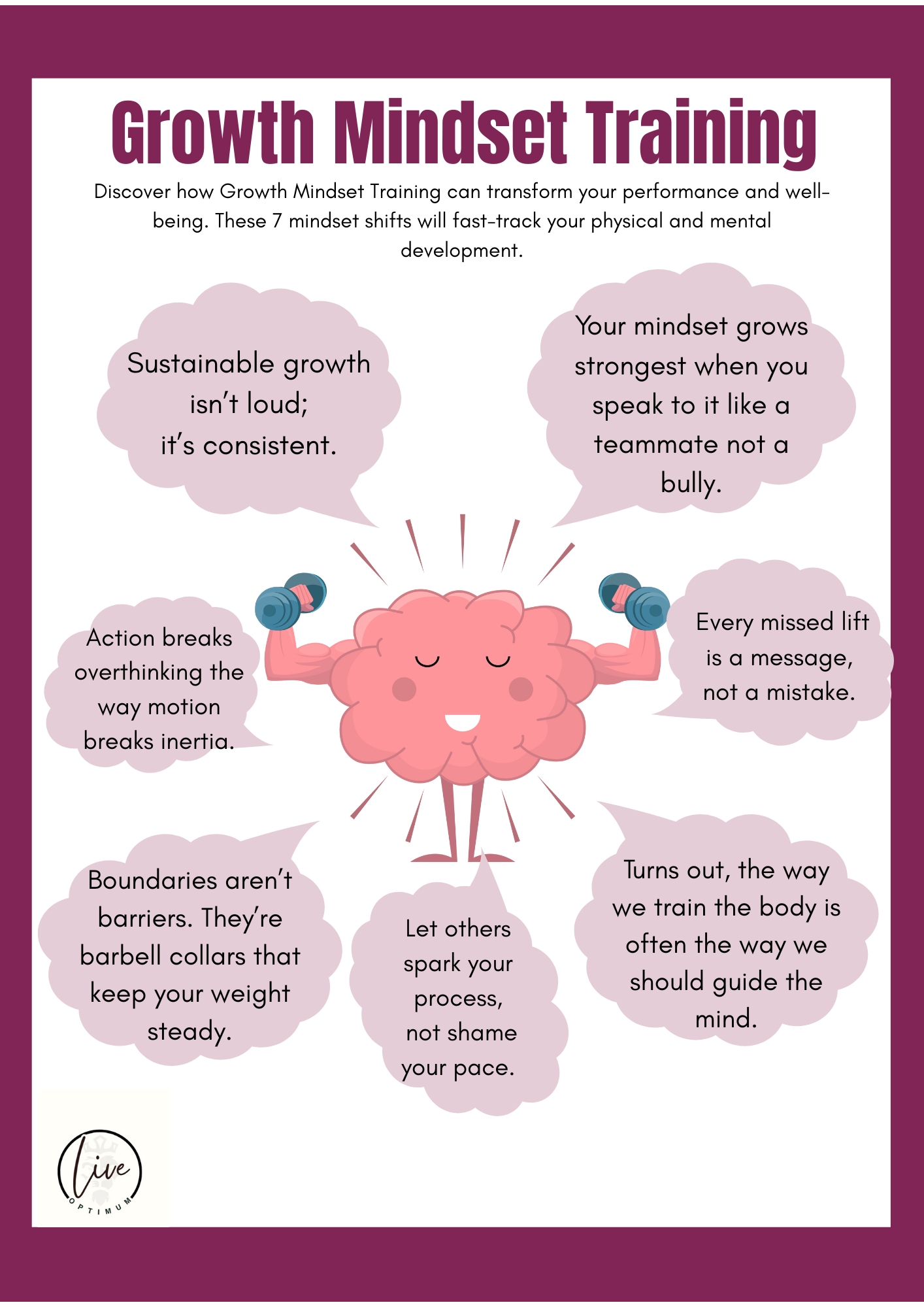
Discover how Growth Mindset Training can transform your performance and well-being. These 7 mindset shifts will fast-track your physical and mental development.
Table of Contents
Why Growth Mindset Training is the Real Game-Changer ?
Ever felt like you’re stuck in a loop, repeating the same workouts, same habits, same mindset and not seeing the results you crave? I’ve been there. That frustrating plateau that creeps in, whether it’s in the gym or in life, has one sneaky culprit: a fixed mindset.
Growth Mindset Training became my reset button. When I finally committed to Growth Mindset Training, I realized the effort itself was the real reward. Once I embraced that effort and struggle are part of growth not signs of failure everything changed. My workouts improved. My recovery got smarter. And mentally? I felt freer.
Here’s the thing: physical gains don’t just come from sets and reps. They come from what happens in our head first. Growth Mindset Training is the link between physical progress and mental resilience.
If you’ve already started your day with “Changing Your Mindset for Greatness in Life : The Ultimate Guide to Mental and Physical Transformation in 2025.” this article is your next logical step. It bridges mindfulness with mental resilience turning your physical habits into mindset power plays.
Let’s dive into the 7 Growth Mindset Training shifts that genuinely boost results fast.
1. From Outcome Obsession to Process Devotion.
I used to be obsessed with results. Like, hardcore. I’d track my workouts, weigh myself almost daily, and scroll Instagram for “body goals” like it was my full-time job. I wanted that big transformation, that six-pack, that proof that I was doing things right. But all that chasing? It left me exhausted. And worse it made me quit the moment results slowed down.
One day, I heard a coach say, “Focus on the reps, not the reward.” That hit hard. I started paying attention to how each lift felt. Growth Mindset Training taught me to celebrate the fact that I showed up, even if I didn’t lift heavier than last week. Slowly, I started falling in love with the process. Progress felt lighter, freer even joyful.
I began applying Growth Mindset Training principles to life too. Instead of obsessing over big wins, I started focusing on the daily reps my morning routine, the food I chose, even how I reacted to stress. Suddenly, life felt like a training ground, not a performance.
Now, every session, whether in the gym or life isn’t about the result. It’s about being present, being consistent, and loving the journey that Growth Mindset Training creates.
Lesson I Learned: The Process as a Mind-Muscle Connection Metaphor.
I used to obsess over numbers how much I lifted, how many days I hit the gym, even my calorie count. But the more I chased outcomes, the more inconsistent I became. It was like I couldn’t enjoy the workout unless it led to visible results immediately.
Then I stumbled upon the mind-muscle connection. It taught me to feel the movement, not just complete it. That shift in focus from the end to the now reframed everything. I applied that to life too. Turns out, when I started enjoying the reps of daily discipline, without obsessing over milestones, I made more progress.
Takeaway: Turns out, the way we train the body is often the way we should guide the mind.
2. From Fear of Failure to Learning Through Lifting.
There was a phase when I was terrified of failing reps. Like, I’d rather skip leg day than risk being seen struggling under a barbell. The fear of failure wasn’t just physical, it followed me everywhere. I hesitated to try new things, avoided conversations that felt uncomfortable, and played it safe in work and life.
Then came that one squat session where I totally collapsed on the last rep. Embarrassing? Yup. But also freeing. No one laughed. My coach just helped me rack the bar and said, “Now we know your limit. Let’s build from here.”
That moment changed everything. I started seeing failures as markers not dead ends. With Growth Mindset Training, I began pushing boundaries safely. In life, I started applying for opportunities I didn’t feel “ready” for. Each fail wasn’t proof I wasn’t good enough. It was a breadcrumb toward growth.
Lesson I Learned: Failure as Form Correction.
Remember the first time you deadlifted with bad form and your lower back screamed for three days? Yep, me too. That pain humbled me and taught me. In hindsight, it wasn’t a failed lift. It was a necessary correction.
Now I look at life setbacks the same way. That job I didn’t get? A form check. That argument with my partner? Another cue for correction. Growth Mindset Training reframed my failures as opportunities to refine not retreat.
Takeaway: Every missed lift is a message, not a mistake.
3. From All-or-Nothing to Micro-Progress Momentum.
Perfectionism was my downfall. I’d create a flawless training plan, follow it for a week, then crash the moment I missed a workout or ate something “off.” It was always all-in or nothing.
Then I started experimenting with micro goals. One push-up. One page of journaling. A 2-minute meditation. At first, it felt like I was cheating. But when I looked back after a month, I realized I was more consistent than ever. And consistency? That was what I’d been missing all along.
I applied the same to lifting. Instead of chasing PRs every week, I celebrated better form or smoother reps. Suddenly, the pressure lifted and the results came faster. Growth Mindset Training made micro-momentum my best friend.
Lesson I Learned: Progressive Overload Meets Progress Over Perfection.
Progressive overload changed the way I looked at strength. Add a little weight each week not max out every time. It’s slow, boring… but damn effective.
I applied this to my productivity habits. Instead of overhauling everything in one weekend, I started adding small habits 5-minute morning walks, stretching post-workout, journaling 2 sentences a day.
Little by little, I became the person I thought I had to hustle to become. The irony? I stopped hustling. I started growing.
Takeaway: Sustainable growth isn’t loud; it’s consistent.
Read more article from the same category “MINDSET DEVELOPMENT”.
4. From Self-Doubt to Strength Through Self-Talk
I used to think my inner critic kept me accountable. Like, if I beat myself up, I’d be more motivated. But the truth? It made everything harder. Every missed workout, every bad meal, every off day, I’d spiral into shame.
One day, I asked myself, “Would I say this stuff to a friend?” Not a chance. So why was I okay saying it to myself?
That’s when I started rewiring my self-talk. Growth Mindset Training helped me treat myself like a coach would. When I lifted, I’d use cues “You got this,” “Stay strong,” “One more.” That same energy bled into everything. Emails. Hard conversations. Creating content. Everything.
And guess what? I started trusting myself more. Believing in myself more. Because I was no longer my own bully, I became my own coach.
Lesson I Learned: Internal Dialogue vs. Coaching Cues.
When I train new lifters, I always say, “Chest up, core tight.” Imagine if I screamed, “You’re weak!” every time they slipped. Sounds ridiculous, right? But that’s how most of us talk to ourselves.
Growth Mindset Training helped me replace internal criticism with cue-based coaching. “I’m overwhelmed” became “I’ll break this into reps.” “I failed” became “That was my warmup set.”
It felt fake at first. But so did holding a plank for 60 seconds. With practice, it became strength.
Takeaway: Your mindset grows strongest when you speak to it like a teammate not a bully.
5. From Burnout to Boundaries with Purpose.
Burnout snuck up on me like a ninja in sneakers. One day I was grinding hard late nights, back-to-back training sessions, endless to-do lists. Then bam. I couldn’t focus, my lifts were trash, and I felt numb.
I thought more effort was the solution. Turns out, it was less.
Rest became a skill. I scheduled real recovery mobility work, breathwork, journaling. Growth Mindset Training reframed rest as strategy. Not as an afterthought but as part of the plan. I stopped saying yes to every invite, every project, every rep.
Setting boundaries didn’t shrink my world. It sharpened it. Now, every “no” I say powers the “yes” that really matters.
Lesson I Learned: Recovery as a Weapon.
I used to think rest days were lazy days. That changed the first time I returned from burnout and felt like I’d aged a decade. I started reading about recovery cycles, sleep hygiene, and nervous system resets.
Turns out, elite athletes don’t train more they recover better.
When I began protecting my evenings, saying “no” to draining events, and guarding my focus time, I felt powerful not guilty.
Takeaway: Boundaries aren’t barriers. They’re barbell collars that keep your weight steady.
6. From Overthinking to Intentional Action.
Some days, I’d plan everything my workout, my meals, my work blocks and still do… nothing. Overthinking became a comfort zone. I felt productive but didn’t produce.
That changed when I committed to one small action. No matter how I felt, I had to take one step forward. Open the app. Tie the shoes. Write the first sentence. Growth Mindset Training taught me to act before I overthink.
It sounds simple, but it saved me from the loop. And once momentum kicked in? The rest followed.
Lesson I Learned: Action as the Anti-Anxiety Rep.
There were mornings I stared at my shoes for 20 minutes before a run. Overthinking stole so many reps from me both in the gym and in life.
Then I tried the “just lace up” method. Not “go for a 5K.” Just… lace the shoes. Usually, that first action melted the hesitation.
The same trick worked for hard conversations, content creation, or even opening my laptop.
Takeaway: Action breaks overthinking the way motion breaks inertia.
7. From Comparison to Competitive Curiosity
Comparison used to crush me. I’d see someone faster, leaner, more successful, and immediately feel behind. Like I wasn’t enough.
But then I started asking, “What can I learn from them?” That flipped everything.
Instead of envy, I felt curiosity. Instead of shame, I felt fire. Growth Mindset Training turned competition into curiosity.
Now, I follow people who are better than me not to feel worse, but to become better. I study their habits, their structure, their mindset. And I borrow what fits.
Lesson I Learned: Competing With, Not Against.
I used to scroll Instagram and think, “They’re miles ahead.” I’d feel discouraged, like my progress wasn’t enough.
Then I remembered how I studied powerlifters I admired not to beat them, but to learn from them. That shift made me curious, not competitive. Inspired, not insecure.
I applied the same lens to life. When someone’s winning, I study their process not their profile.
Takeaway: Let others spark your process, not shame your pace.
Conclusion: This Is Just the Beginning.
The truth is, Growth Mindset Training isn’t something you do once it’s a loop you live inside.
These 7 Growth Mindset Training shifts have changed how I lift, how I think, and how I show up. They’ve helped me bounce back from setbacks faster and stay grounded when everything around me feels chaotic.
If you’re ready to keep building both brain and body, then stick around.
Because next up we’re diving into: “Gratitude Practice Throughout Your Strength Journey for Better Outcomes.”
Let’s keep growing.
TOP 15 FAQ
-
What is growth mindset training?
It’s practicing mindset shifts seeing failure as learning, focusing on process over outcome, boundary setting to rewire thought patterns that fuel progress.
-
What are the 5 ways you can develop a growth mindset?
From the article: shift from outcome obsession → process devotion; fear of failure → learning; all-or-nothing → micro-progress; self-doubt → positive self-talk; overthinking → intentional action.
-
Is growth mindset a CBT skill?
Yes in essence. It aligns with CBT (Cognitive Behavioral Therapy) ideas like reframing negative thoughts and replacing self-criticism with constructive self-talk.
-
Growth mindset training (general question)
Growth mindset training teaches you to lean into struggle, value consistent effort, and reframe setbacks making mindset part of your growth strategy, not just physical effort.
-
Growth mindset training for teachers
Teachers can model learning over outcome, encourage student effort, use micro-wins, and emphasize courage in trying over perfection. These mirror shifts in the article.
-
Growth mindset training for employees
Employees benefit by using feedback as learning, setting small consistent goals, seeing failures not as threats but opportunities, using self-talk to stay motivated.
-
Growth mindset training for adults
For adults: start with identifying fixed mindset cues, then apply shifts focus on process, take boundary rest, action before overthinking to break old habits.
-
Growth Mindset Training outline
7 shifts:
– Process devotion.
– Learning through lifting.
– Micro-progress.
– Positive self-talk.
– Boundaries.
– Intentional action.
– Competitive curiosity.Use these as your framework.
-
Growth mindset certification
Coursera : Many courses (from universities) include mindset training modules. Sometimes you’ll earn a certificate on completion.
Udemy : Several mindset oriented courses, watch out for those that specifically say “Growth Mindset.” They’re affordable and self paced.
Mindset Works : The place co-founded by Carol Dweck (the psychologist behind “growth mindset”). They offer teacher oriented certification programs.
edX : Similar to Coursera, sometimes universities offer professional certificate tracks related to personal development and mindset.
Professional coaches/training companies : Some life coaches or corporate training firms offer certification in growth mindset frameworks. Always check reviews & credentials. -
How do mindset shifts help overcome plateaus?
They change what you attend to: instead of pressure to always show results, you value consistency & learning. That reduces burnout & reboots progress.
-
How does setting boundaries help in growth mindset?
Boundaries protect mental energy saying no to overcommitment, rest when needed so you don’t burn out chasing results.
-
Why is micro progress helpful vs all or nothing?
Micro goals prevent overwhelm. They give wins often, build momentum, and make consistency easier than sporadic intense efforts.
-
What type of self talk supports growth mindset?
Coaching self talk: encouraging phrases like “I learn from this,” “I’ll show up again,” or “Every rep counts.” Shifts internal critic into ally.
-
How do I act intentionally instead of overthinking?
Pick one small first step (tie shoes, write one sentence, start stretch). Action breaks inertia. Then adjust as you go.
-
How can curiosity replace comparison?
Study others to learn, not to compete. Use their success to fuel your growth rather than self-criticism. Comparison becomes insight instead of discouragement.