Discover 7 primal triggers that boost pre workout focus through mindful warm ups. Transform scattered gym energy into laser sharp mental clarity before training.
Table of Contents
Introduction
Ever walked into the gym feeling like your brain’s still stuck in traffic?
I’ve been there more times than I’ll admit. You’re physically present, but mentally you’re replaying that work meeting or thinking about dinner plans. Research shows 67% of gym goers waste their first 15 minutes because they lack mental engagement.
Pre workout focus isn’t about chugging another stimulant or blasting music. It’s about reconnecting with something primal that lives beneath our modern distraction layer. Our ancestors didn’t need motivation to hunt or escape danger. They had instant, automatic focus triggered by survival instincts.
What if we could tap into those same neural pathways before touching a barbell? That’s what mindful warm ups do. They wake up dormant primal triggers that shift your nervous system from “just going through the motions” to “fully alive and present.” In this guide, you’ll discover how pre workout focus becomes automatic when you activate the right biological switches.
1. Breath Patterns That Activate Your Sympathetic System.
Controlled breathing is the fastest way to shift from calm to readiness for physical effort, and it directly enhances pre workout focus.
I used to think breathing exercises were trendy wellness nonsense until I tried box breathing before squats. Within 90 seconds, my heart rate adjusted, my hands stopped fidgeting, and the weight didn’t feel intimidating anymore. It felt like a conversation I was ready to have.
Your autonomic nervous system doesn’t distinguish between real danger and intentional stress. When you manipulate breath tempo, you’re telling your body, “Something important is about to happen, get ready.” Slow, deep nasal inhales flood your bloodstream with oxygen while activating the diaphragm.
Here’s what changed everything for my pre workout focus. I started treating my first three minutes like a pilot’s pre flight checklist. Four seconds in through the nose, hold for four, out for four, hold for four.
My scattered thoughts about emails and groceries didn’t vanish, but they got quieter. The mental static reduced to background noise instead of a blaring television I couldn’t turn off. The metaphor I use is tuning a guitar. You’re not creating focus from nothing, you’re adjusting tension until everything resonates at the right frequency.

Deep breathing isn’t passive relaxation. It’s active recalibration that builds genuine pre workout focus without relying on caffeine or stimulants.
Proven Approach Questions:
- What does your breathing pattern look like in the first 60 seconds after entering the gym?
- Can you identify the exact moment your mind shifts from “daily life mode” to “training mode”?
- How might intentional breath control replace your reliance on external stimulants?
- What physical sensations accompany mental focus for you: warmth, tingling, steadiness?
- If breath is the bridge between mind and body, how sturdy is yours right now?
Read our “Free Mindset Development & Recovery Tools for Strength Athletes: 2026 Guide.
2. Ground Contact Drills That Root Your Attention.
Physical connection with the floor activates proprioceptive awareness that anchors wandering thoughts to present sensation and strengthens pre workout focus.
Barefoot mobility work changed everything. I used to rush through generic stretches while scrolling my phone, half present and already thinking three exercises ahead. Then a trainer asked me to spend two minutes just feeling my feet press into the ground during a deep squat hold.
It sounds stupidly simple, but something profound happens when you deliberately notice where your body contacts the earth. Your nervous system gets flooded with proprioceptive feedback. These are sensors in joints and muscles that tell your brain exactly where you are in space.
This isn’t abstract mindfulness fluff. It’s measurable neurological input that crowds out mental distraction and creates authentic pre workout focus. Think of your attention like water. Left alone, it spreads thin across a thousand tiny worries.

But when you create a single point of intense physical sensation, like the arch of your foot supporting your bodyweight, that water flows into one channel. It deepens. It concentrates.
I’ve started every workout for the past year with 90 seconds of deliberate contact drills. Toe spreading, finger splaying, pressing palms flat and noticing which fingers bear more weight. It’s not glamorous, but the payoff is immediate. Your brain stops living five minutes in the future and drops anchor in the now.
This simple practice does more for pre workout focus than any motivational video ever could.
Proven Approach Questions:
- When was the last time you consciously felt the texture of the gym floor beneath your feet?
- What percentage of your warm up currently involves zero mental presence?
- How might barefoot movement change your awareness of body position and balance?
- Can you identify three specific points of contact your body makes with the ground right now?
- What would it feel like to train with your attention fully inhabiting your body?
3. Visual Narrowing Techniques for Tunnel Vision Clarity.
Deliberately restricting your visual field mimics predatory focus and eliminates peripheral distractions that fragment attention, directly improving pre workout focus.
There’s a reason elite athletes talk about “being in the zone.” Their visual attention narrows, not metaphorically, literally. Neuroscience research shows optimal performance correlates with reduced peripheral awareness and heightened focal vision.
I discovered this during a power outage at my gym. With only emergency lighting, the usual visual noise disappeared. I could only see about six feet clearly. That workout was one of my most focused sessions ever, not despite the darkness but because of it.
You don’t need a blackout to recreate this level of pre workout focus. Before your first working set, practice soft gaze focusing. Pick a single point and let everything else blur slightly. Hold this for 20 to 30 seconds.
You’re training your visual cortex to enter a state similar to predatory tracking. Irrelevant stimuli get filtered out automatically. The mental shift feels like walking from a noisy restaurant into a quiet library.
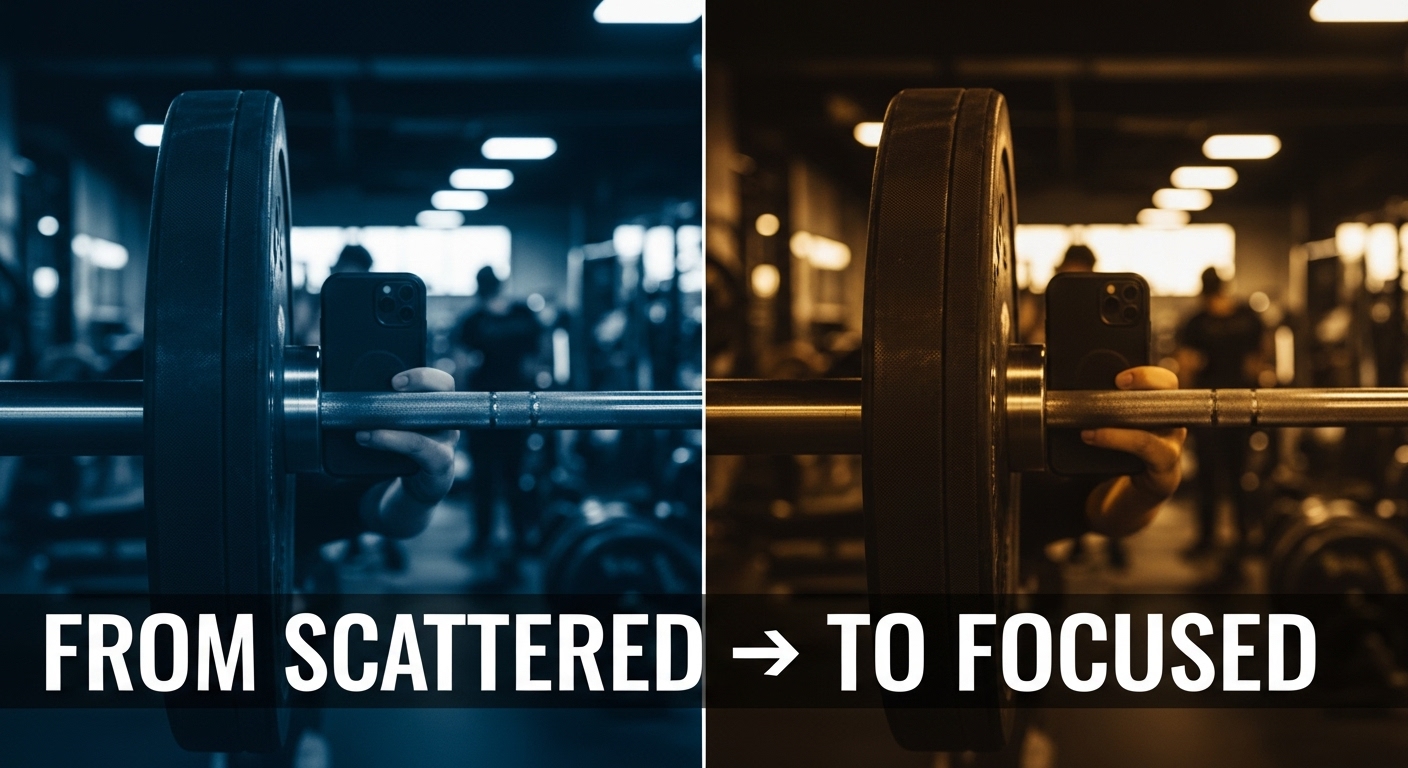
I’ve used this before heavy compounds especially. Staring at the center knurl mark on a barbell for 15 seconds creates a micro trance state where doubt loses its grip. The weight becomes the only thing that exists in that moment, and pre workout focus becomes effortless.
Proven Approach Questions:
- How much of your warm up involves your eyes wandering to phones, mirrors, or other people?
- What would change if you treated your gaze like a spotlight instead of a floodlight?
- Can you recall a time when intense focus made everything else disappear from awareness?
- How might eliminating visual distraction improve your form and mind muscle connection?
- What single visual target could become your pre lift anchor point?
4. Movement Variability to Wake Up Neural Pathways.
Unpredictable, playful movement patterns activate dormant motor neurons and break autopilot training habits while building sustainable pre workout focus.
I fell into a brutal rut three years ago where every warm up was identical. Five minutes on the treadmill, same stretches in the same order, then straight to routine. My body was present, but my brain had checked out. Pre workout focus was nonexistent.
Then I watched my toddler niece play at a park. She wasn’t stretching or doing mobility drills. She was crawling, spinning, jumping, rolling, reaching. Completely unpredictable, totally engaged, absolutely focused.
Her movement had variability, and variability demands attention. Your brain can’t autopilot through novelty. Now I dedicate three minutes to “exploratory movement” every warm up.

Sometimes bear crawls, other days deep lunges with a twist, or single leg balances with eyes closed. There’s no program, just movement that makes my brain actually think about what my body is doing. This isn’t random chaos. It’s intentional unpredictability that rebuilds pre workout focus from the ground up.
Think of it like shaking a snow globe. All those neural pathways that got settled and dusty? Suddenly they’re active again, firing in combinations they haven’t used in months. Motor control research shows movement variability during warm ups improves subsequent performance because it increases neural activation and body awareness.
The first time feels awkward. But within a week, you’ll notice this three minute “play session” creates more genuine pre workout focus than 20 minutes of mindless cardio ever did.
Proven Approach Questions:
- How much of your current warm up could you perform while completely distracted?
- When was the last time you moved in a way that surprised your own body?
- What would happen if you eliminated all predictability from your warm up for one week?
- Can you identify which movement patterns your brain has put on “autopilot mode”?
- How might playful, varied movement recapture the engagement you felt as a beginner?
Also Read
“Micro Habits 5 best recovery practices: Sustainable Mindset Development.”
5. Auditory Anchoring Through Rhythmic Priming.
Strategic sound patterns synchronize neural oscillations and create temporal frameworks that organize mental energy and amplify pre workout focus.
Music selection is where most people stop. Pump up songs, aggressive beats, whatever gets adrenaline moving. I did this for years. But sometimes the music made me more scattered, not less. Energy without direction isn’t the same as pre workout focus.
Rhythmic priming is about using sound strategically to entrain your brainwaves. Studies show your nervous system naturally synchronizes to external rhythms. A consistent 120 to 140 BPM track doesn’t just pump you up. It gives your brain a metronome to organize around.
I experimented by creating a specific “transition soundtrack.” Not my workout playlist, but a five minute sequence I only play during warm ups. Same songs, same order, every single time. Classical conditioning kicked in within two weeks.
Now, the second those opening notes hit, my brain knows exactly what state it’s entering. It’s like Pavlov’s bell, except instead of salivating, I’m dropping into focused readiness. The metaphor is a runway. You don’t go from parked to airborne instantly.
That’s what rhythmic priming does for pre workout focus. It’s smooth, inevitable momentum that carries you from scattered to centered. Here’s the key: consistency matters more than genre. Pick something with a steady tempo and use it only for warm ups.
Your brain will create an association so strong that eventually, the music itself becomes a primal trigger for pre workout focus.
Proven Approach Questions:
- How often does your current music selection create distraction instead of focus?
- What would change if you used sound as a ritual signal rather than entertainment?
- Can you identify a tempo range that matches your optimal training heart rate?
- How might auditory conditioning accelerate your mental transition into training mode?
- What song could become your personal “focus activation” cue?
6. Tactical Discomfort Exposure for Stress Inoculation
Brief, voluntary exposure to physical discomfort before training builds mental resilience and reframes workout challenges as manageable stress, enhancing pre workout focus.
Cold water exposure taught me more about pre workout focus than any motivational video. I started ending warm ups with 60 seconds of cold water on my wrists and neck. The first time, I hated it. But something fascinating happened: the weights didn’t feel hard anymore.
This is stress inoculation in action. Your nervous system has limited bandwidth for perceiving threat. When you deliberately expose yourself to controlled discomfort like cold, breath holds, or isometric holds, you’re recalibrating your “this is hard” threshold. Suddenly, your baseline for pre workout focus shifts entirely.
I’m not talking about punishment or toughness theater. This is strategic exposure that recontextualizes challenge. If your baseline is always comfortable, any discomfort feels massive. But if you regularly dip into controlled stress during warm ups, your range expands.
My current protocol: 30 second wall sit at maximum depth, followed by 10 slow breaths. My quads scream, but when I approach the squat rack, everything feels lighter. I’ve already crossed a discomfort threshold. Pre workout focus isn’t born from comfort. It’s born from knowing you can handle hard things.
The primal trigger here is ancient. Our ancestors didn’t have the luxury of waiting until they “felt ready” to hunt or defend. They moved through discomfort as a baseline state. Brief discomfort exposure during warm ups isn’t punishment. It’s remembering what authentic pre workout focus actually feels like.
Proven Approach Questions:
- What’s the last thing you did voluntarily that was genuinely uncomfortable before training?
- How might controlled discomfort change your perception of workout difficulty?
- Can you identify the exact moment discomfort shifts from threat to challenge?
- What would happen if you treated your warm up as mental toughness training?
- How has seeking comfort potentially weakened your ability to sustain focus under stress?
7. Intention Setting Through Micro Goal Articulation.
Verbally or mentally declaring specific, measurable outcomes for the session activates your reticular activating system and creates powerful pre workout focus.
I used to walk into the gym with vague intentions. “Good workout,” “push hard,” “don’t skip anything.” Basically useless. My brain had no clear target, so attention scattered across everything equally. There was zero pre workout focus.
Then I started doing something embarrassingly simple. Before touching equipment, I’d say one sentence out loud. “Today I’m here to own the eccentric tempo on every pressing movement.” Suddenly, pre workout focus wasn’t something I hoped would show up. It became automatic because my brain’s attention filter had clear instructions.
Goal setting research shows vague aspirations create vague results. But specific intentions activate goal directed neural networks. Your brain loves clarity. It doesn’t know what to do with “train hard,” but it knows exactly what to do with “maintain 3 second eccentrics on every squat rep.”
The metaphor is a flashlight versus floodlight. Vague intentions illuminate everything weakly. Specific micro goals create a beam so concentrated you can see details you’d otherwise miss. My warm up isn’t complete until I’ve articulated my flashlight target for that session.
Here’s what shocked me: on days when I clearly stated my intention, I could remember every set afterward. On vague days, the whole workout blurred into generic effort. Clarity doesn’t just improve performance during training. It creates lasting neural encoding that makes every rep count double, and it transforms pre workout focus from a hope into a guarantee.
Proven Approach Questions:
- What specific outcome could you commit to before your next training session?
- How often do you finish a workout unable to clearly recall what you accomplished?
- What would change if every session had one measurable focus instead of twenty vague efforts?
- Can you identify the difference between “trying hard” and “executing a specific intention”?
- How might verbalizing your goal out loud increase commitment and focus?
Conclusion
Pre workout focus isn’t reserved for professional athletes with zero distractions. It’s a skill you build through intentional warm up practices that tap into primal neural triggers: breath control, ground contact, visual narrowing, movement variability, rhythmic priming, discomfort exposure, and clear intention setting.
These seven techniques aren’t complicated. Most take less than five minutes total. But they bridge the gap between physically showing up and mentally showing up, which is where most progress actually lives. You don’t need more motivation or better supplements to achieve pre workout focus. You need better activation rituals that respect how your ancient nervous system actually works.
Start with one trigger. Master the breath work or ground contact drills for two weeks before adding another. The compound effect builds faster than you’d expect. Within a month, you’ll walk into training sessions feeling like a different athlete. Not because your programming changed, but because your mental preparation and pre workout focus finally matched your physical potential.
Your next workout starts the moment you decide it does, not when you touch the first weight. Make that decision deliberate, and everything else follows.
Top 15 FAQ
-
Does pre workout make you focus?
It can help, but real focus comes from breath control, grounding, and intention setting, your nervous system creates sharper clarity than stimulants.
-
What is the best pre orkout for focus?
The best “focus booster” is activating your primal triggers, breath patterns, visual narrowing, and grounding, before any supplement.
-
Is preworkout good for ADHD?
It may help some, but mindful warm ups work better by reducing scattered attention and giving your brain a clear anchor before training.
-
Can I take preworkout for studying?
You can, but using breathing drills and single point visual focus triggers far more mental clarity than caffeine alone.
-
Gorilla Mode pre workout
A popular stimulant formula, but your article shows focus improves more from neural activation than high dose stimulants.
-
Best Pre Workout for focus and pump
A structured warm up with breath control and movement variability creates natural focus and “pump readiness” without overstimulation.
-
Pre workout focus ingredients
Caffeine, tyrosine, and choline help, but your strongest “ingredient” is activating your sympathetic system through targeted breathwork.
-
Pre workout for focus Reddit
Users often recommend stimulants, but your method shows that grounding and intention setting produce deeper, more reliable focus.
-
Gorilla Mode Lightning Pre Workout
It provides fast stimulation, but your article shows that sensory control and narrowing attention give cleaner, more stable focus.
-
Gorilla Mode pre workout review
Strong energy, but can feel chaotic; mindful warm ups create a calmer, more controlled mental state before lifting.
-
Gorilla Mode pre workout ingredients
Stimulants help alertness, but your primal warm up triggers provide focus rooted in the nervous system, not chemicals.
-
Legion Pulse Pre Workout
A clean formula, yet your guide proves the biggest shift in readiness comes from grounding drills and rhythmic priming.
-
What is pre workout focus?
It’s the shift from scattered thoughts to directed intention, created through breath, sensory control, and micro goals.
-
How to improve pre workout focus naturally?
Use grounding, breath patterns, tunnel vision gaze, and rhythmic sound cues, your brain locks in without stimulants.
-
Why does my focus disappear at the gym?
Because your brain stays in “daily life mode.” Activating primal triggers before training switches you into performance mode.