
Most people fail at being consistent not because they lack discipline but because they build routines around motivation instead of systems. This guide breaks down why routines collapse after week one and exactly how to fix that.
Your routine falls apart after a week because motivation fades and your system was never built to survive without it. Being consistent requires habit loops, not willpower. The fix is simpler than you think, but only if you stop relying on how you feel.
Table of Contents
Quick definition.
Being consistent is the practice of repeating a behavior reliably over time, independent of mood, motivation, or external pressure, until it becomes an automatic habit loop.
Key takeaways.
- Motivation is a spark. Systems are the fuel. Without one, the other dies fast.
- Week one feels easy because novelty triggers dopamine, not discipline.
- Willpower depletes daily. Routines built on it always collapse.
- The habit loop (cue, routine, reward) is the real engine of consistency.
- Identity, not goals, is what makes behaviors stick long term.
- Small wins compound. Perfection kills progress before it starts.
- Rest and recovery are part of a sustainable routine, not the enemy of it.
The Step by Step Fix: Rebuild Your Routine the Right Way.
1. Audit what you already do, not what you wish you did.
Write down your actual daily habits for 3 days. Honest data beats optimistic planning every time.
2. Anchor new habits to existing ones using habit stacking.
Attach a new behavior after something you already do automatically. “After I pour my morning coffee, I will write for 10 minutes.”
3. Shrink the habit until it feels almost embarrassingly small.
A 2 minute version of your habit beats a 60 minute version you skip. Tiny actions lower resistance and build identity.
4. Design a clear reward for completing the loop.
Your brain needs a signal that the behavior was worth repeating. Even a checkmark or a pause of appreciation works.
5 Plan your failure in advance, not your success.
Decide now: “If I miss one day, I will do the 2 minute version the next morning, no matter what.” One miss is an accident. Two misses is the start of a new habit the wrong one.
6. Track streaks but never let streak breaking become shame.
Progress tracking builds momentum. However, routines are permanently destroyed by shame following a missed day. Track to learn, not to punish.
Changing Your Mindset for Greatness in Life.
Why Week One Feels Easy (And Why That’s Actually the Problem).
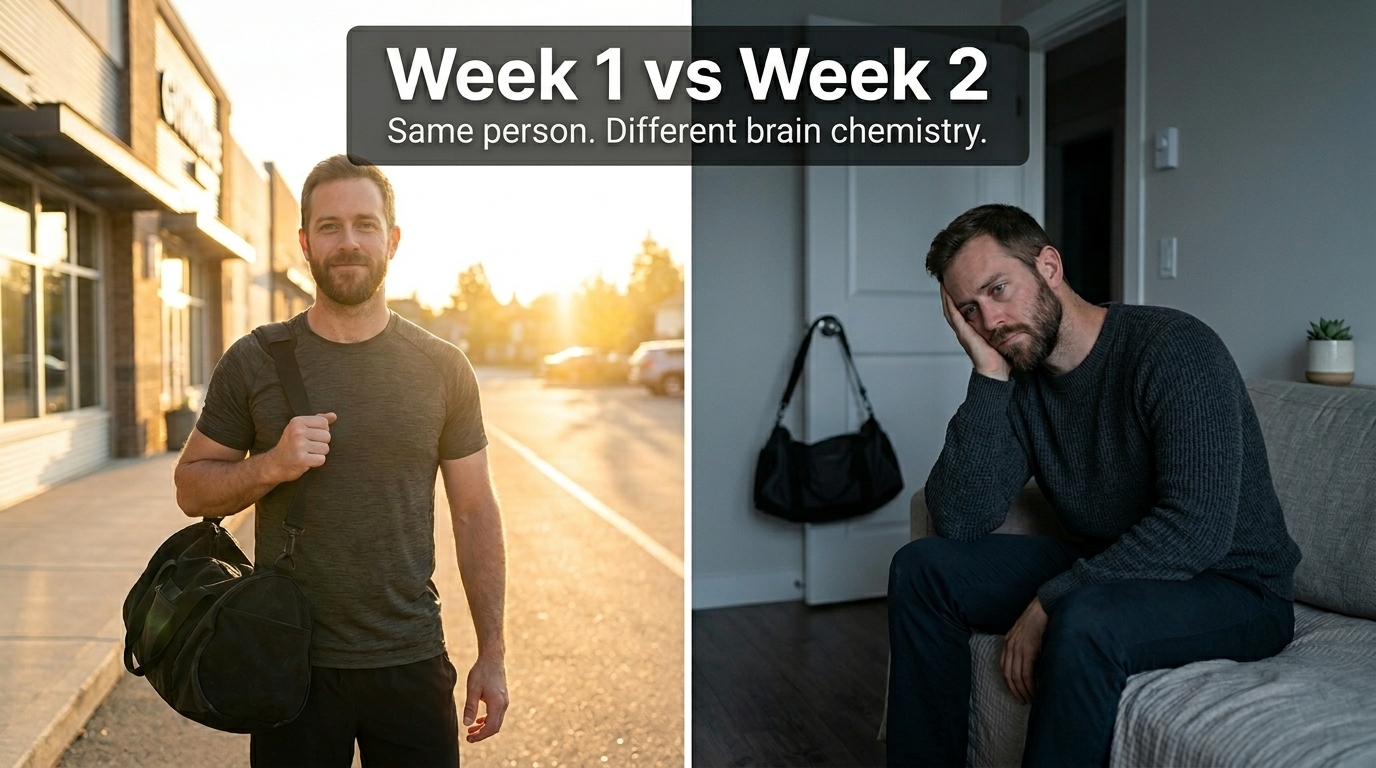
Being consistent in week one is almost effortless because novelty hijacks your brain chemistry in the best possible way.
When you start something new, your brain releases dopamine in anticipation of a reward. That gym session on day two, that 5am wake up on day three, that journaling habit on day four all of them feel strangely good. Not because you are being consistent in any disciplined way, but because your brain is simply excited about something new.
Here is the trap. By day eight or ten, the novelty is gone. The dopamine response quiets down. And suddenly the same action that felt exciting now feels like a chore. You did not get weaker. Your brain just stopped celebrating the ordinary. And without realizing it, being consistent starts to feel like a burden rather than a choice.
Most people interpret this as a personal failure. It is not. It is biology doing exactly what it was designed to do: conserve energy by reducing enthusiasm for things that are no longer new. The people who stay on track are not superhuman. They just understood early that being consistent was never supposed to feel exciting forever.
This is exactly where being consistent gets hard for most people, and also where it matters most. The fix is to stop chasing that week one feeling and start building a system that works without it.
- Have you noticed your energy for a new habit drops around day 8 to 12?
- What were you counting on to keep you going when motivation faded?
- What would change if you treated low motivation as normal instead of a warning sign?
- What is one habit you abandoned that you now realize was just entering its hardest phase?
Motivation vs. Systems: The Real Reason You Keep Restarting.
Being consistent is impossible when your entire routine depends on feeling ready.
Motivation is emotional. It rises when things feel new, exciting, or urgent. It drops when you are tired, stressed, bored, or overwhelmed. Building a routine around motivation is like building a house on sand: it looks fine until conditions change. And the moment conditions change, being consistent becomes the first thing you sacrifice.
Systems, on the other hand, are structural. They reduce the number of decisions you have to make. They remove friction. They make the right behavior the path of least resistance instead of the path of most effort. That is what being consistent actually looks like in practice. Not a burst of willpower every morning, but a quiet structure that runs whether you feel like it or not.
Think of it this way. You do not decide every morning whether to brush your teeth. There is no internal negotiation. You just do it. That is a system operating at full maturity, and that is being consistent at its most effortless. Your new habits are not there yet, and expecting them to function like a years old routine on day four is where most people go wrong.
- How many of your current habits require a daily decision to begin?
- What would happen if you removed one decision from your morning routine?
- Where in your routine do you feel the most internal resistance?
The Habit Loop: What Your Brain Actually Needs to Stay Consistent.
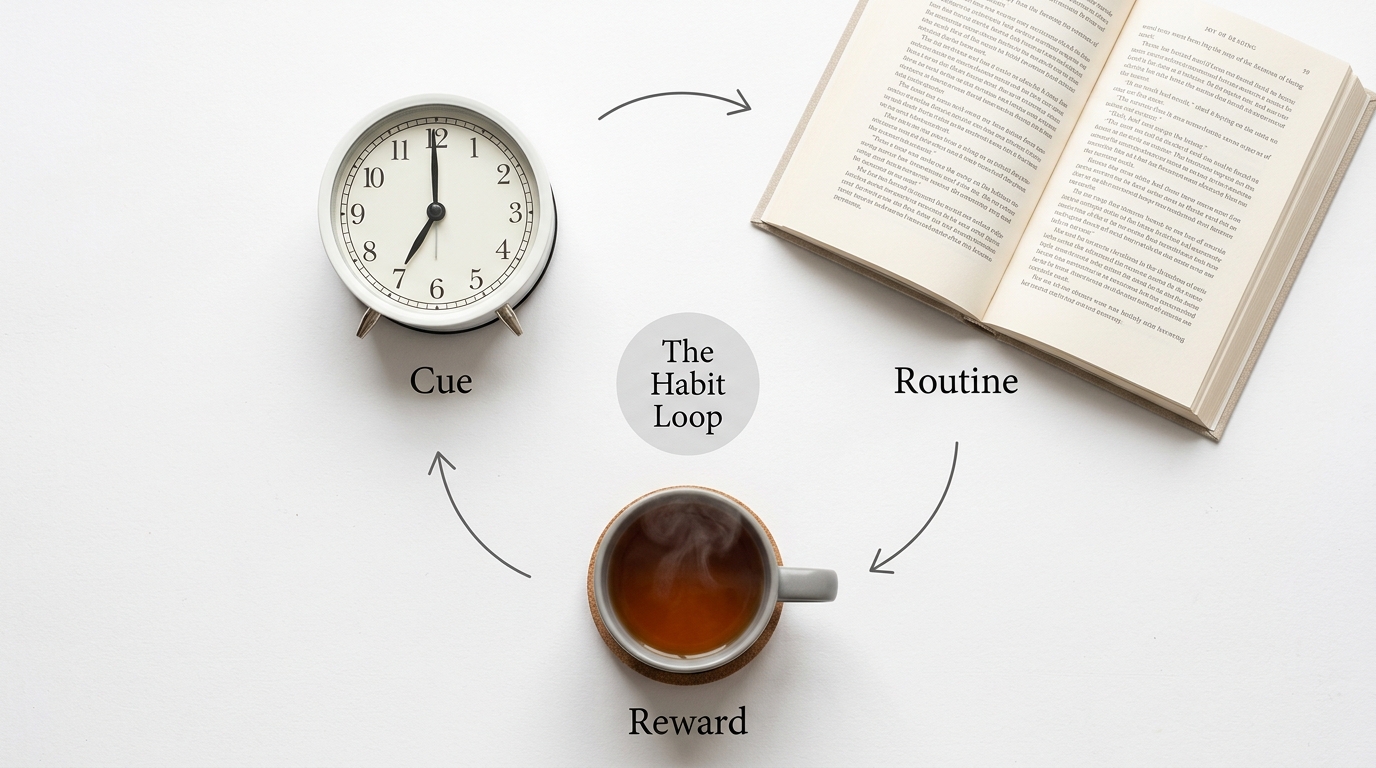
The habit loop is the core mechanism behind being consistent, and ignoring it is why most routines fail silently.
Every habit has three parts: a cue, a routine, and a reward. The cue triggers the behavior. The routine is the behavior itself. The reward is what your brain uses to decide whether to repeat the cycle. Miss any one of these three parts and being consistent with that habit becomes an uphill battle every single day.
Most people design only the middle part. They plan the workout, the journal session, the deep work block but they never define what triggers it or what feeling follows it. Without a clear cue, the behavior relies on memory and willpower. Without a reward, the brain has no reason to automate it. This is why so many people feel like they are trying hard at being consistent but still feel like they are starting over every week.
For example, if you want to build a reading habit, the cue might be your alarm going off 20 minutes before sleep. The routine is reading a physical book. The reward is the natural calm that follows. Over time, the alarm alone starts to create a pull toward the book. That is the loop working. That is being consistent without forcing it.
- What is the specific cue for your most important new habit?
- Does your routine have a clear, satisfying ending signal?
- Is the reward immediate or delayed? Delayed rewards are harder to build loops around.
- Which habit in your life is already a full loop, running without thought?
Willpower Depletion: Why “Just Be Disciplined” Is Terrible Advice.
Willpower is finite. Using it up on small decisions means you have less of it for the habits that matter most.
Research in behavioral psychology consistently shows that self control operates like a muscle. It performs well early in the day and under low stress. It degrades with use. By evening, after a full day of decisions, meetings, and social friction, the willpower you need for your 9pm workout or your wind down routine is almost entirely depleted.
This is why people who eat clean all day often binge at night. It is not moral weakness. It is a depleted executive function making the easiest available choice.
The practical answer is not to develop more willpower. It is to design your routine so that willpower is barely required. Place your most important habits early in the day. Pre decide your choices. Reduce the options available to you at your lowest energy moments.
- At what time of day do you try to execute your hardest habits?
- How many small decisions are you making before you get to your most important task?
- What is one choice you could pre decide tonight to reduce friction tomorrow?
Read more articles from our “Mindset Development” Category:
– Why am I Feeling So Lost and Empty Even When Life Looks Fine.
– Laser Focus: 5 Evidence-Based Ways to End Distraction.
– Active Recovery Workout: 7 Strategic Ways to Reset Fatigue.
The Identity Shift That Makes Being Consistent Feel Natural.

Lasting consistency comes from who you believe you are, not from what you are trying to achieve.
Goal based thinking sounds like: “I want to run a 5k.” Identity based thinking sounds like: “I am someone who moves their body every day.” The goal is a destination. The identity is a direction. When the goal is reached or missed, behavior often collapses. But an identity continues to generate behavior automatically.
Every small habit you complete is a vote for a particular identity. Showing up to your desk at 7am is a vote for being a focused person. Going for a 10 minute walk after lunch is a vote for being someone who prioritizes health. The votes accumulate. The identity strengthens. And then consistency stops feeling like effort and starts feeling like character.
This shift does not happen overnight. But it is the difference between someone who is trying to be consistent and someone who simply is consistent without needing to try.
- What identity are your current daily actions voting for?
- Is your routine aligned with who you want to become or just what you want to accomplish?
- What would a person with your desired identity do on a low motivation day?
Comparison: Motivation Based vs. System Based Routines.
| Aspect | Motivation Based Routine | System Based Routine |
|---|---|---|
| Trigger | How you feel that morning | A predefined cue. |
| Consistency | High in week 1, drops fast | Slow to build, then stable. |
| Energy required | High willpower daily | Low once habit forms. |
| Response to bad days | Skips the habit | Executes the minimum version. |
| Long term result | Repeated restart cycles | Compound growth over time. |
| Identity impact | Reinforces inconsistency | Builds a reliable self image. |
Common Mistakes People Make When Trying to Stay Being Consistent.
Mistake 1: Too many habits at once at first.
Fix: Pick one habit, stabilize it for 3 to 4 weeks, then layer on the next. Stack, don’t stack up and collapse.
Mistake 2: Setting the bar so high that a busy day makes it impossible.
Fix: Define a minimum viable version of every habit. On hard days, that is your standard, not a failure.
Mistake 3: Relying on calendar reminders instead of environmental cues.
Fix: Place physical triggers in your environment. Running shoes by the door. Water bottle on the desk. Visible cues beat digital ones every time.
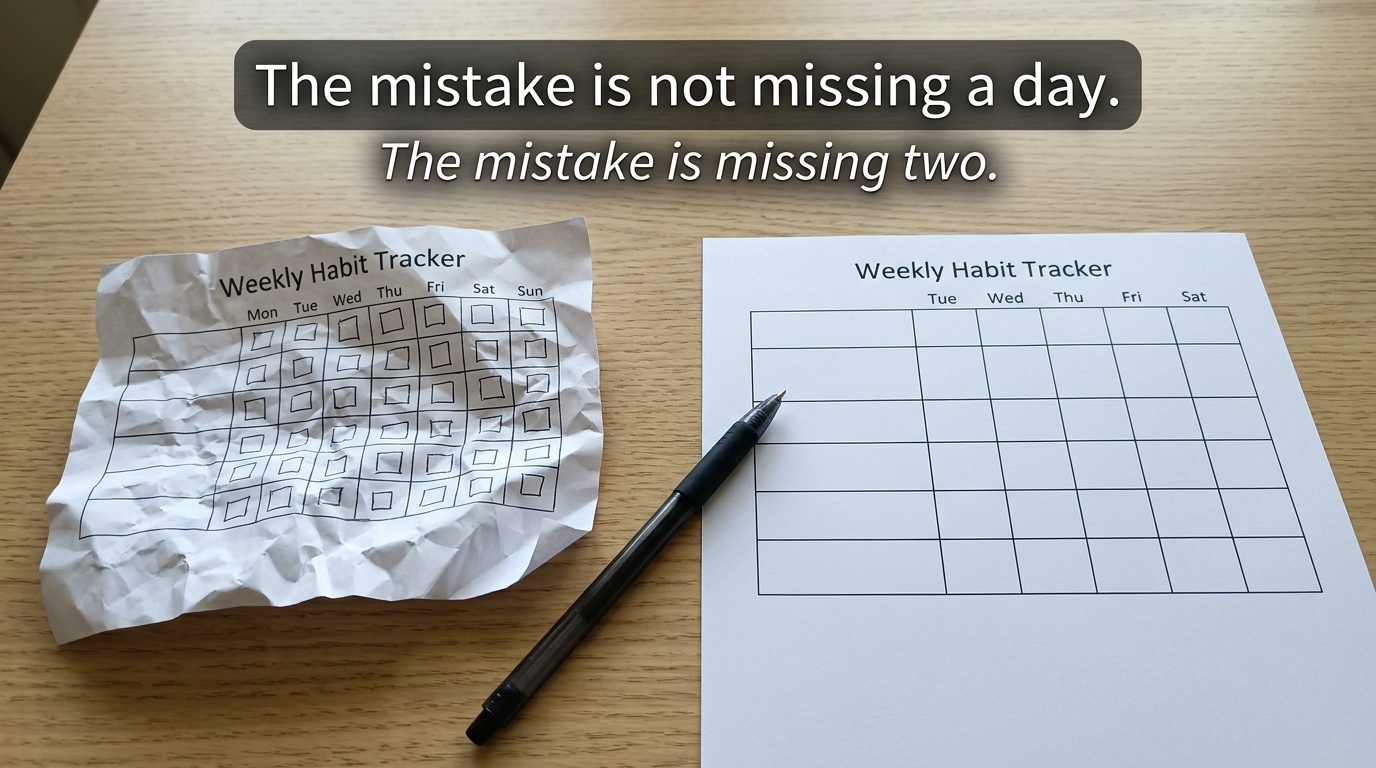
Mistake 4: Treating a missed day as a reason to quit.
Fix: The rule is never miss twice for being consistent. One miss is random. Two misses starts a new pattern. Recover the next day, every time.
Mistake 5: Building a routine that looks impressive but feels miserable.
Fix: Enjoyment is not optional. If you hate every step, the habit will not survive stress. Find a version of the behavior you can tolerate on your worst day.
Mistake 6: Not tracking anything.
Fix: A simple streak tracker or journal creates accountability without pressure for being consistent. What you do not measure, you cannot improve.
Final summary.
- Being consistent is not about willpower. It is about designing a system that works without it.
- Week one feels easy because of dopamine novelty, not discipline. Expect the drop and plan for it.
- The habit loop (cue, routine, reward) is the architecture your brain needs to automate behavior.
- Shrink your habits until they are almost too easy. Small wins build identity over time.
- Never miss twice. Recovery speed matters more than perfection.
- The goal is not a perfect routine. It is a resilient one that survives your hardest days.
Honestly, I have restarted the same morning routine more times than I can count. And each time I believed that I was the issue. Too lazy. Too undisciplined. Not serious enough.
It took me an embarrassingly long time to realize the routine itself was broken, not me. I had built it around the version of myself that exists at peak energy and peak motivation. That version shows up about twice a week on a good month.
What finally worked was building for the tired, distracted, slightly overwhelmed version of me. The one who is real almost every day.
If you take nothing else from this: design your routine for your worst self. Your best self will not need it.
People Also Asks !
-
What does being consistent mean?
Being consistent means repeating a behavior reliably over time, independent of mood or motivation, until it becomes an automatic habit loop.
-
What is the meaning of being consistent?
It means showing up for your habits and routines even when motivation is gone, driven by systems and identity rather than feelings or willpower.
-
What makes a person consistent?
A consistent person builds systems, not motivation-based routines. They use habit loops, shrink tasks to a minimum, and never miss twice after a setback.
-
How do you stay consistent?
Anchor habits to existing cues, shrink them until they feel easy, reward completion, and plan your recovery before you fail, not after.
-
What stops people from being consistent?
Relying on motivation, starting too many habits at once, setting the bar too high, and treating one missed day as total failure.
-
How to stay consistent with goals?
Shift from goal based to identity based thinking. Every small habit is a vote for who you are becoming, not just what you want to achieve.
-
What are some synonyms for being consistent?
Reliable, disciplined, steady, dependable, persistent, unwavering, habitual, committed, systematic, and focused are all close alternatives.
-
What are good quotes about being consistent?
“Design your routine for your worst self” is a good way to put it. Your best self will not need it.” That is the mindset consistent people live by.
-
What does being consistent mean in a relationship?
In a relationship, being consistent means showing up reliably in your actions and behavior, not just your words, regardless of mood or circumstance.
-
What does a consistent person look like in a relationship?
They follow through on what they say, maintain steady emotional presence, and do not fluctuate between effort and absence based on how they feel that day.
-
What does the Bible say about being consistent?
Biblical consistency reflects faithfulness and steadfastness, doing what is right repeatedly over time, not perfectly, but reliably, which mirrors the habit loop principle of small repeated actions building character.
-
What does being consistent with God mean?
It means maintaining a daily spiritual practice regardless of emotion or circumstance, treating faith like a system rather than something you return to only when motivated.
-
Why does my routine fall apart after one week?
Because week one runs on novelty dopamine, not discipline. Once that fades around day eight, motivation drops and any routine built on feeling collapses fast.
-
Is willpower enough to stay consistent?
No. Willpower depletes daily. Routines built on it always fail under stress. Systems, habit loops, and pre-made decisions are what sustain consistency long term.
-
How long does it take to become consistent?
Habits take 18 to 254 days to form depending on complexity. The 21-day rule is untrue. Simple habits form faster, but all require a working cue-routine-reward loop.