
Table of Contents
Why am I so lazy when I have so much to do? It’s not discipline, it’s a recovery mistake draining your decisions, focus, and output all at once.
You sat down to finish the work. The deadline was real, the stakes were clear, and you had the time blocked out. But you opened the tab, stared at it for four minutes, and closed it. Not laziness in the way people usually mean it not avoidance, not fear. Just a complete absence of forward momentum. That moment hits students before exams, professionals before important calls, business owners before strategic decisions, and people who train before sessions that should feel routine. The question “why am I so lazy” isn’t a character question. It’s a systems question.
If you keep asking yourself why am I so lazy even when the task matters, here is the direct answer: your body and brain are running a recovery deficit they haven’t been permitted to clear. Laziness in people who are otherwise driven is not a motivation failure. It is a physiological and neurological response to accumulated stress load that has exceeded available recovery capacity. Whether that stress came from heavy training, back-to-back meetings, exam prep, or the constant pressure of running a business, the system responds the same way: it throttles output to protect itself. What you experience as laziness is your central nervous system enforcing a hard spending limit.
What “laziness” actually means when you are someone who normally performs ?
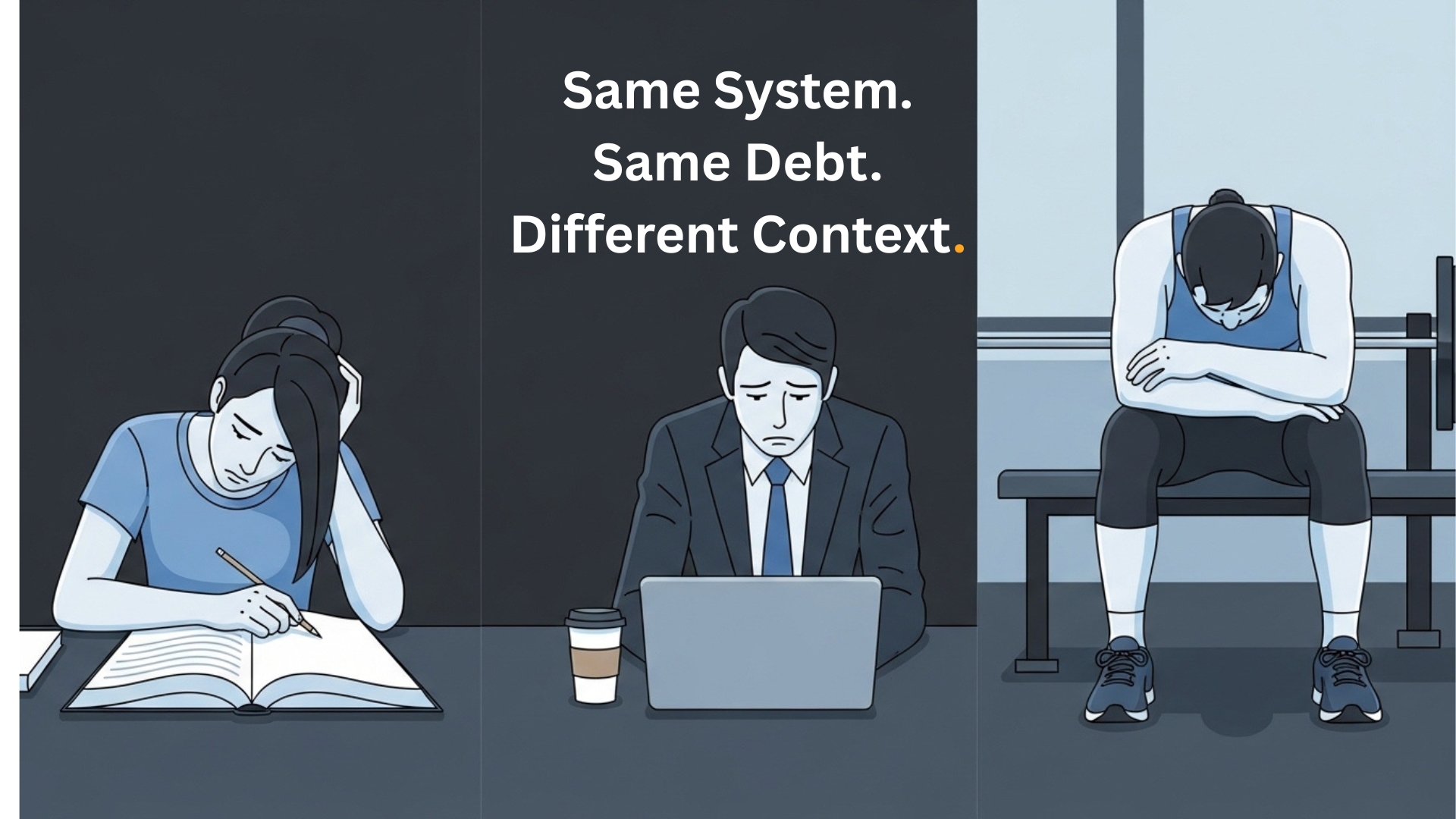
What laziness actually means in a performance context: It is not a personality trait or a deficit of willpower. In students, professionals, athletes, and business owners who are otherwise high-functioning, laziness is the body’s protective downregulation response when the central nervous system is overdrawn. It presents as heavy limbs, slow thinking, inability to initiate tasks, poor decision quality, and a general absence of drive, even after sleep and it signals that recovery has fallen behind stress output.
This framing matters because it changes the entire strategy. When you believe the problem is motivation, you try motivational fixes pressure, guilt, caffeine, forcing through it. When you understand the problem is a depleted system, you stop pushing harder and start asking what the system actually needs. The first approach deepens the deficit. The second clears it.
Why am I so lazy is the wrong question. The right question is: what is my total stress load, and what has my recovery actually been?
Read my previous article on “How to Reset Nervous System: A Simple Guide.”
The Recovery Debt Cycle: how output stops without warning ?
Here is the problem stated plainly: most high-performing people treat recovery as passive. Sleep happens, meals happen, the weekend arrives, and they assume the system resets. But recovery is an active process. The nervous system, the prefrontal cortex (the brain’s planning and decision-making center), the hormonal regulation system, and the body’s stress response architecture all require specific, deliberate inputs to reset. When those inputs are underprovided consistently, the deficit compounds. At a certain threshold, the system stops authorizing output regardless of your intentions.
The mechanism: your autonomic nervous system runs on a balance between sympathetic activation (stress, effort, output) and parasympathetic recovery (rest, repair, reset). When sympathetic load from training, executive decision-making, information overload, emotional demands chronically exceeds parasympathetic recovery, the brain begins reducing voluntary effort before structural damage occurs. Exercise physiologist Tim Noakes mapped this with the central governor model: the brain is an active limiter, and it will reduce your perceived capacity to act before your body or cognitive systems are clinically depleted.
For a student, this shows up as staring at notes that no longer form meaning. For a job holder, it’s the 3pm fog where sending a routine email requires more effort than it should. For a business owner, it’s the meeting where a decision needs making and you simply cannot assemble your thinking clearly enough to make it. For someone training, it’s sitting on the edge of the bed with your shoes in hand and putting them back down. Same mechanism. Different context.
Why Am I So Tired? 7 Hidden Reasons You’re Drained.
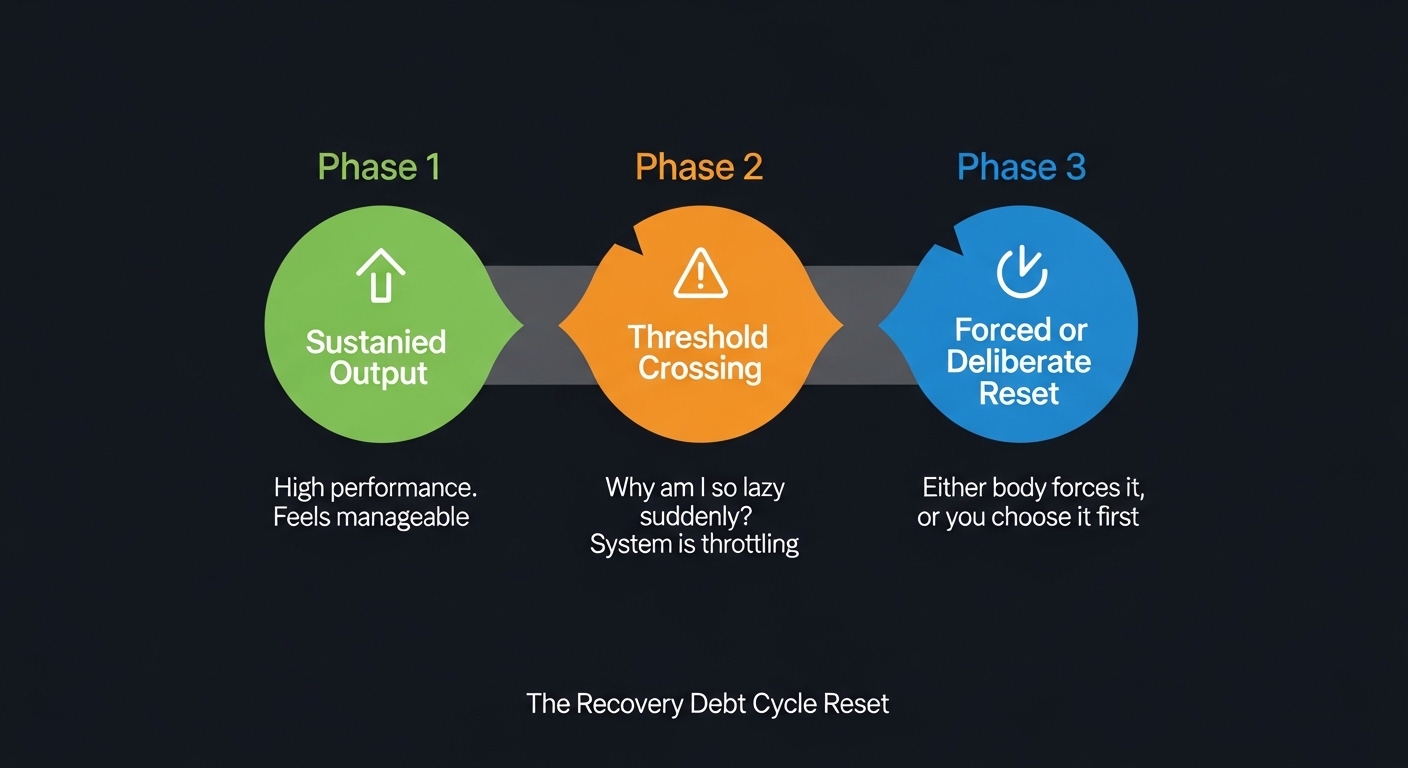
This is what I call The Recovery Debt Cycle Reset, a framework from the PMHD (Physical & Mental Health Development) system. The cycle has three phases: sustained high output where you feel fine; a threshold crossing where the system throttles, this is the sudden “why am I so lazy” moment; and then either forced recovery or deliberate structured reset. Most people only hit phase three when the body forces it. The PMHD approach intervenes at phase two, before the debt becomes a crisis.
Your body does not randomly become lazy. It becomes strategic about resource allocation when the account runs low.
Also read: Functional Core Workout: 7 Smart Habits to Fix Balance.
The mind-body connection that makes this a professional performance problem, not just a fitness one.

The reason this matters for professionals, students, and business decision-makers not just people in the gym is that mental and physical stress draw from the same biological reserve. This is the core insight of the PMHD (Physical & Mental Health Development) system: the mind and body are not parallel systems with separate fuel. They share infrastructure, and depletion in one domain degrades performance in both.
When your brain is running on empty and simple decisions feel heavy, your physical output follows. When your body is in a recovery deficit from training or poor sleep, your cognitive performance especially strategic thinking, risk assessment, and creative problem-solving degrades even on what should be rest days. The professional who trains hard and sleeps five hours to fit in more work is not optimizing. They are depleting both accounts simultaneously.
Why You Self-Sabotage Right Before Things Get Good.
I’ve tracked this across my own cycles. The weeks I felt the most paralyzed where I kept asking why am I so lazy when I have so much to do were never the single hardest training weeks or the single busiest workdays. They were the weeks where all of it converged: heavy training load, dense cognitive demand, emotionally draining interactions, and compromised sleep. The body treats each as a draw from the same account.
Mental fatigue and physical fatigue are the same debt written in different languages.
There is one more layer that rarely gets discussed: the cost of unmade decisions. Every choice you defer, every problem you carry without resolving, every open loop in your head these are active draws on cognitive resources. A business owner carrying three unresolved strategic questions into a workout has already taxed that session before touching a weight. A student sitting down to study while mentally managing a difficult personal situation has already surrendered a portion of available focus before opening a book. Recovery is not only about sleep and training. It is about the total weight the system is carrying at any given time.
Let’s take a deep dive into “Mind – Body Integration” category articles.
What actually clears the debt when you feel too stuck to do anything.

The solution is counterintuitive for people wired to perform: you have to reduce output before you can restore it. Not permanently temporarily, and deliberately. Pull training intensity to roughly 40–50% of normal for one to two weeks. Identify the two or three highest cognitive-load activities in your day and either batch them into a single protected window or reduce their frequency. Treat sleep quality not just duration as a performance input: consistent wake time, reduced screen exposure in the final hour, a cooler environment.
When rest looks like laziness…
For professionals and students specifically: close your open loops. Write down the decisions you’re carrying and either make them or schedule when you will. The mental weight of unresolved commitments is a real physiological load, and reducing it produces measurable improvement in cognitive clarity within days.
The inputs that support recovery across both physical and mental systems are:
- Consistent sleep and wake times (more important than total hours)
- Low-intensity resistance training to maintain neuromuscular signaling without adding debt
- Walking not as cardio, but as a genuine parasympathetic down-regulator
- Deliberate low-stimulation periods daily no screens, no content, actual quiet
- Closing open cognitive loops through capture and scheduling rather than ongoing mental carrying
When drive returns when tasks feel like engagement rather than obligation that is the signal to reload intensity. Returning before that signal is the most common mistake. The returning energy feels like proof the problem is solved, so people immediately redeploy at full load. The debt isn’t fully cleared yet. Give it the full window.
Laziness that hits suddenly in an otherwise driven person is almost always systemic overload and the fix is never to push harder through it.
Q: Why am I so lazy even though I have important things to do? A: Your stress load physical, cognitive, and emotional has exceeded recovery capacity. The brain throttles output to protect itself. It’s depletion, not discipline failure.
Q: Why am I so lazy after a productive week? A: A productive week builds recovery debt. The laziness after is the system collecting what was borrowed. Structured output reduction clears it not more pushing.
Q: Does laziness affect decision-making and work performance? A: Yes. The prefrontal cortex responsible for decisions and planning degrades first under under-recovery. Laziness is the brain rationing its highest-cost cognitive functions.
Most people who read this will recognize themselves in it and then immediately look for the fastest way to get back to full output. That instinct is exactly what causes the cycle to repeat. The reset is not the interruption of your performance, it is the mechanism that makes sustained performance possible at all.
If you want to go further, explore how decision fatigue connects to physical training output on liveoptimum.com, and how the PMHD total stress load framework applies to structuring high-performance days across work, study, and training simultaneously.
Written by Bippy (Md. Rishad Hasan Bippy), founder of liveoptimum.com and writer & content creator of physical and mental performance development, overall personal development.
TOP 15 FAQ’S
-
What is the main cause of laziness?
It’s not personality. It’s recovery debt where stress load exceeds recovery capacity, forcing your brain to reduce output.
-
How do I stop being so lazy?
Reduce output temporarily, improve sleep consistency, walk daily, and clear mental overload before increasing effort again.
-
Am I lazy or ADHD?
If it’s sudden and linked to stress, it’s likely recovery debt. ADHD is consistent across contexts, not tied to overload cycles.
-
What is the 3 second rule for laziness?
It pushes action quickly, but fails under recovery debt because your system blocks output, not your intent.
-
Why am I so lazy and unmotivated ?
Your nervous system is overdrawn. Motivation drops when recovery falls behind stress, forcing energy conservation.
-
Why am I so lazy to study ?
Cognitive overload and poor recovery reduce focus capacity, making studying feel heavier than it actually is.
-
Why am I so lazy reddit ?
Most answers miss it. It’s not laziness, it’s accumulated stress and under-recovery reducing your ability to act.
-
I want to be successful but I’m lazy
You’re likely overloading your system. Success requires managing recovery, not just pushing harder.
-
Why am I so lazy to workout ?
Your body detects fatigue and blocks effort. It’s protecting itself from deeper physical stress overload.
-
I’m too lazy meaning
It usually means your system is conserving energy due to stress, not that you lack discipline.
-
Why am i so lazy to do anything
You’ve crossed the recovery threshold. The brain limits all output to prevent further depletion.
-
Why am I so lazy and tired ?
Poor recovery plus high stress creates fatigue, slowing both physical and mental performance.
-
Why do I feel lazy even after sleeping?
Sleep alone isn’t enough. Cognitive and emotional stress also need active recovery to restore energy.
-
Why does laziness hit suddenly?
You hit the recovery threshold. The brain switches from output mode to protection instantly.
-
How long does it take to fix laziness from burnout?
With reduced load and proper recovery inputs, clarity and drive usually return within 7-14 days.