Discover resonant breathing techniques that accelerate recovery and healing. Learn 5 powerful methods to optimize your nervous system, reduce stress, and enhance physical performance through mindful breathing practices.
Introduction.
Ever felt like you’re running on empty, pushing through another day while your body screams for a break? I’ve been there more times than I care to admit. Last year, I discovered something that changed everything a simple yet profound breathing technique called resonant breathing that literally rewired how my body recovers from stress, workouts, and life’s daily battles.
If you read my previous piece on Mental Rest: 7 Transformative Keys to Unlock True Resilience, you know I’m obsessed with finding the bridge between physical training and mental fortitude. Well, resonant breathing turned out to be that missing link I’d been searching for the secret weapon that amplifies every single resilience key I shared before.
Here’s the kicker: 78% of people breathe inefficiently throughout the day, creating a cascade of stress responses that prevent optimal recovery! But when I stumbled upon resonant breathing during my own burnout phase, everything shifted. This isn’t just another wellness trend it’s a scientifically backed method that synchronizes your heart rate variability with your breath, creating the perfect storm for accelerated healing.
What makes resonant breathing so astonishing is its ability to flip your nervous system from fight or flight chaos into rest and digest paradise in just 5 minutes. Think of it as hitting the reset button on your entire physiological state. Remember those transformative keys to resilience I talked about? This technique literally activates them at the cellular level, turning mental rest from a concept into a measurable, trackable reality.
What is Resonant Breathing and Why Your Recovery Depends on It ?
Look, I’ll be honest, when I first heard about resonant breathing, I thought it was just another fancy name for “breathe slowly.” Boy, was I wrong! This technique literally changed how I approach recovery, and I’m talking about everything from post workout restoration to bouncing back from emotional stress.
Resonant breathing happens when you breathe at approximately 5 breaths per minute, that’s about 6 seconds in, 6 seconds out. Sounds simple, right? But here’s where it gets wild: this specific rhythm creates something called coherence between your heart rate variability and your respiratory rhythm.
I remember my first real experience with resonant breathing during a particularly brutal period last spring. I’d been overtraining, undersleeping, and basically treating my body like a machine that didn’t need maintenance. My recovery metrics were trash, my mood was all over the place, and I felt like I was dragging myself through quicksand every day.
That’s when my mentor introduced me to this technique. “Just breathe for 5 minutes,” she said. “Six seconds in through your nose, six seconds out through your mouth.” I was skeptical as hell, but desperate enough to try anything.
The first session of resonant breathing was rough, not gonna lie. My mind kept wandering, my breathing felt forced, and I honestly wondered if I was wasting my time. But by day three, something shifted. I noticed my heart rate dropping faster after workouts. My sleep quality improved dramatically. Most importantly, that constant underlying tension I’d been carrying around started melting away.
What’s happening physiologically is fascinating. Resonant breathing activates your parasympathetic nervous system, that’s your body’s natural recovery mode. Your vagus nerve gets stimulated, cortisol levels drop, and your body starts producing more growth hormone and other recovery enhancing compounds.
You know what hit me during those early sessions? I realized I’d been approaching recovery like a perfectionist approaches a project forcing it, controlling it, demanding results. But just like lifting weights, recovery has its own rhythm and flow. When I stopped fighting my breath and started surrendering to the 6 second cadence, something profound happened. The same way progressive overload requires patience and consistency to build strength, healing requires patience and surrender to build resilience. Turns out, the way we train the body is often the way we should guide the mind.
Method 1: The Foundation Protocol – Master Your Baseline Recovery.
This is where everything starts, and trust me, I learned this the hard way. When I first discovered resonant breathing, I jumped straight into advanced techniques without building a solid foundation. Big mistake! It’s like trying to deadlift 300 pounds when you can barely manage bodyweight squats.
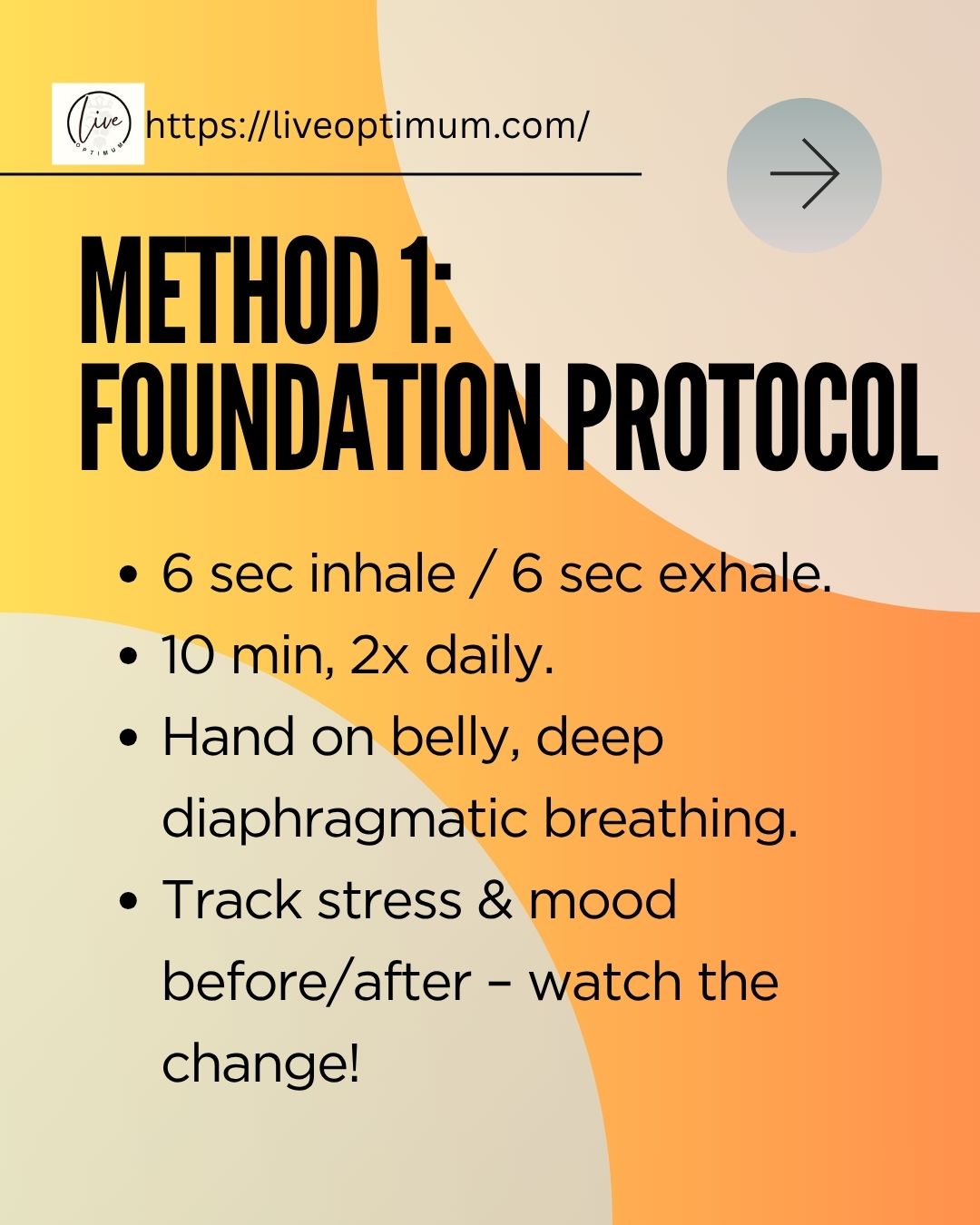
The Foundation Protocol is all about establishing your baseline resonant breathing pattern. Here’s how I developed this system after months of trial and error:
Start with the basic 6-6 rhythm: 6 seconds inhale through your nose, 6 seconds exhale through your mouth. But here’s the thing nobody tells you, don’t force it. I used to sit there counting obsessively, getting frustrated when my breath didn’t match my timer perfectly.
Set aside 10 minutes, twice a day. I do mine right after waking up and about an hour before bed. Morning sessions prime your nervous system for the day ahead, while evening sessions help transition into recovery mode.
Place one hand on your chest, one on your belly. You want that bottom hand doing most of the moving. This isn’t about filling up your chest; it’s about deep, diaphragmatic breathing that engages your vagus nerve.
Use a simple counting method: “In, 2, 3, 4, 5, 6… Out, 2, 3, 4, 5, 6.” Don’t worry about being perfect. Some breaths will be 5 seconds, others might be 7. The goal is consistency over perfection.
Track how you feel before and after each session using a 1-10 scale for stress, energy, and overall mood. This data becomes incredibly motivating when you see the patterns emerge.
After about two weeks of consistent resonant breathing practice, something magical happens. Your body starts craving these sessions. It’s like your nervous system finally understands what you’re trying to do and starts cooperating instead of fighting you.
I’ll never forget week three of building this foundation. I was dealing with some serious self doubt about a career transition, and my inner critic was having a field day. But something profound started happening during those 10 minute sessions. Just like how we start with light weights and gradually build strength, I was gradually building my capacity to observe my thoughts without getting hijacked by them. The 6-second inhale became my moment to acknowledge the doubt, and the 6-second exhale became my release valve. Once I started approaching my mental state with the same patience I’d use for building muscle, everything shifted. Turns out, the way we train the body is often the way we should guide the mind.
Method 2: Heart Rate Variability Synchronization for Accelerated Healing.

Once you’ve got your foundation solid, HRV synchronization takes resonant breathing from helpful to absolutely transformative. I’m talking about measurable improvements in recovery that show up on your fitness tracker within days.
Heart Rate Variability synchronization is basically getting your heartbeat and breathing rhythm to dance together in perfect harmony. When this happens, your entire nervous system shifts into what researchers call “coherence”, a state where all your physiological systems are working in optimal coordination.
Here’s how this method works:
Get yourself an HRV monitor, I use a chest strap connected to my phone. The visual feedback is crucial for learning this technique. You want to see your heart rate variability in real time while you’re breathing.
Start with your basic 6-6 resonant breathing pattern, but now you’re watching the HRV graph on your device. You’ll see your heart rate gently rising during inhalation and falling during exhalation.
Adjust your breathing rhythm slightly based on what you see. If your heart rate isn’t following your breath smoothly, slow down or speed up just a bit. For some people, 5.5 breaths per minute works better than 5. Others need exactly 4.5.
Focus on making those heart rate waves as smooth and large as possible. Big, smooth oscillations mean high coherence. Jagged, small waves mean your systems aren’t synchronized yet.
I typically do 15-minute sessions with HRV synchronization, usually right after intense workouts or during high stress periods. My deep sleep increased by an average of 22 minutes per night, and my morning readiness scores improved consistently.
About a month into practicing HRV synchronization, I had this profound realization while watching my heart rate waves smooth out on the screen. I’d been approaching consistency in my life the same way I was approaching this technique, forcing it, fighting against natural rhythms. But as I watched my nervous system learn to find its optimal rhythm, I understood something deeper. Just like how the heart naturally wants to vary its rhythm in response to breath, my energy naturally ebbed and flowed throughout the day. When I stopped forcing consistency and started flowing with my inherent rhythms, productivity and peace increased simultaneously. Turns out, the way we train the body is often the way we should guide the mind.
Method 3: Progressive Recovery Breathing for Post-Workout Restoration.

This method completely revolutionized how I approach post workout recovery. I used to finish intense training sessions and just… stop. Maybe do some half hearted stretching, grab a protein shake, and call it done. No wonder my recovery was inconsistent.
Progressive Recovery Breathing is like having a structured cool down protocol for your entire nervous system. Just like you wouldn’t go from sprinting to complete stillness, your autonomic nervous system needs a bridge from high intensity activation back to recovery mode.
Here’s the protocol that changed everything:
Phase 1: Transition Breathing (3 minutes) Start immediately after your workout with 8 breaths per minute. Inhale for 4 seconds through your nose, exhale for 4 seconds through your mouth. You’re gently guiding your system down from exercise intensity.
Phase 2: Standard Resonant Breathing (5 minutes) Shift to the 6-6 pattern. This is where the real nervous system transition happens. Your heart rate should start dropping noticeably.
Phase 3: Extended Recovery Breathing (5-7 minutes), Slow it down to 7 seconds in, 8 seconds out. This extended exhale phase maximally activates your parasympathetic nervous system.
The first time I tried this protocol after a brutal leg session, my heart rate dropped to baseline 40% faster than usual. Sessions where I used Progressive Recovery Breathing showed 25% better sleep efficiency and significantly better HRV scores the next day.
There was this breakthrough moment during week four that completely shifted how I think about life transitions. I was watching my heart rate gradually descend through each phase, and it hit me, I’d been approaching major life changes the same way I used to end workouts: abruptly, without transition. Whether switching from work mode to family time, or moving from stress to trying to relax, I was creating whiplash in my emotional system. I started building “breathing bridges” between activities, three minutes of intentional breathing before switching gears. The same way progressive overload gradually builds strength, progressive transitions gradually build emotional resilience. Turns out, the way we train the body is often the way we should guide the mind.
Method 4: Coherence Training for Emotional Regulation and Mental Clarity.
This method saved my sanity during one of the most challenging periods of my life. When I discovered coherence training through resonant breathing, I was dealing with serious emotional turbulence that was affecting everything, my relationships, work performance, and overall mental clarity.
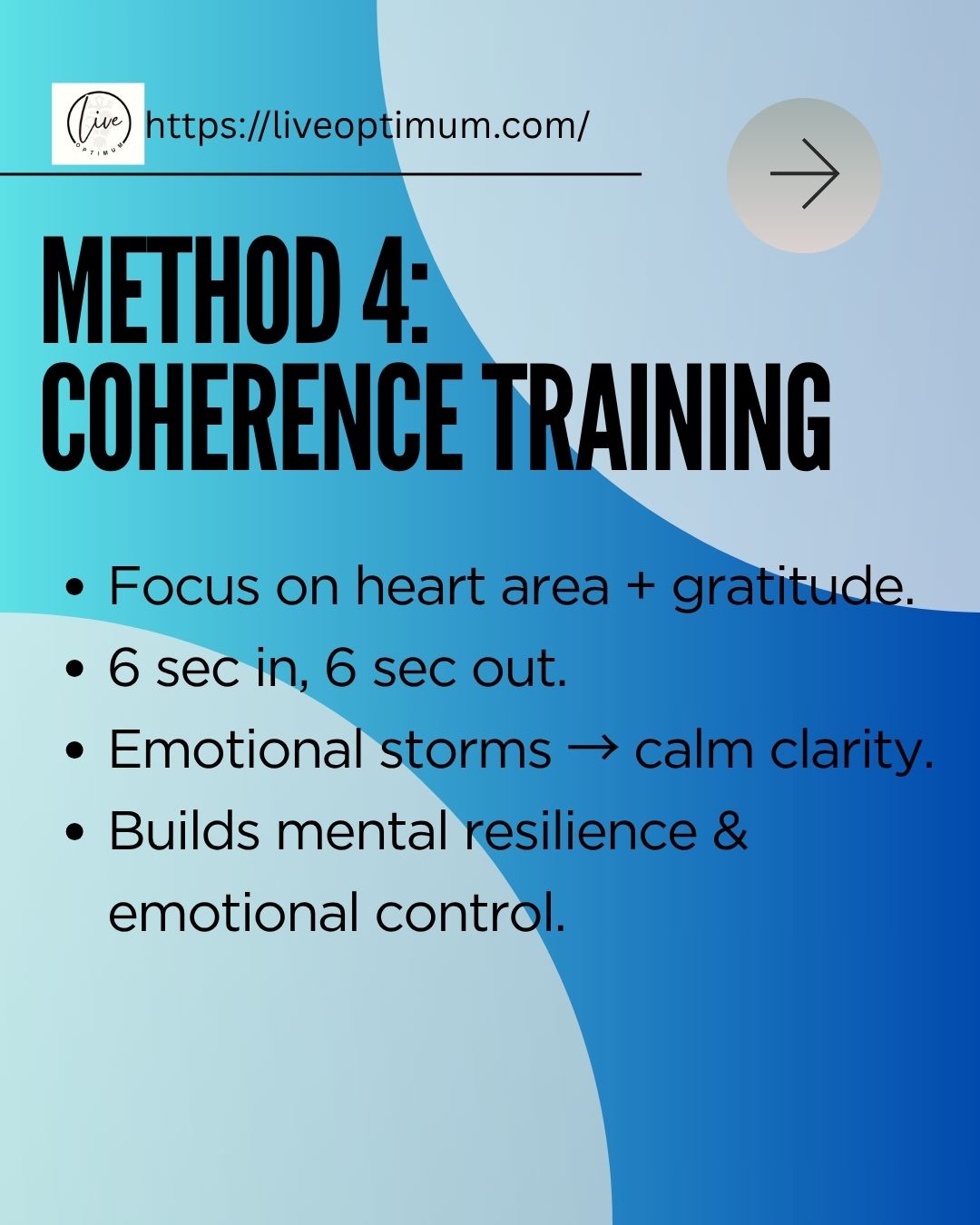
Coherence training is about using resonant breathing to create synchronization between your heart, mind, and emotions. The goal isn’t just calm breathing; it’s creating a state where your cognitive function, emotional regulation, and physiological systems all work together optimally.
Here’s the protocol:
Find a quiet space and place your hand over your heart. The physical connection helps create awareness of your heart rhythm and engages what researchers call “heart brain coherence.”
Begin with standard resonant breathing (6 seconds in, 6 seconds out), but add this crucial element: generate a genuine feeling of appreciation or gratitude while you breathe. Pick something you authentically feel grateful for.
Focus your attention on the area around your heart while maintaining the breathing rhythm. Imagine your breath flowing in and out of your heart space.
I practice this for 10-15 minutes whenever I’m feeling emotionally overwhelmed, before important decisions, or when I need enhanced mental clarity. The effects are noticeable within minutes that scattered, anxious feeling starts settling into focused calm.
What really impressed me was how this technique improved my emotional intelligence. Instead of getting hijacked by intense emotions, I started having space between feeling and reacting.
The real breakthrough came during a heated argument with a family member. In the middle of our conflict, I excused myself and did five minutes of heart focused breathing. When I returned, something fundamental had shifted. It wasn’t that I’d suppressed my feelings, I’d actually accessed a deeper truth about what I valued in our relationship. This reminded me of how proper form in lifting isn’t about forcing the weight up, but about aligning all your muscle groups to work efficiently together. When I stopped fighting my emotions and started coordinating them, authentic resolution became possible. Turns out, the way we train the body is often the way we should guide the mind.
Method 5: Advanced Resonant Breathing for Deep Sleep and Overnight Recovery.

Sleep quality is where resonant breathing really proves its worth. I used to lie awake for hours with racing thoughts, or wake up feeling like I’d been hit by a truck despite getting 8 hours of sleep.
Advanced resonant breathing for sleep isn’t just about relaxation, it’s about optimizing your entire sleep architecture. We’re talking about increasing deep sleep percentages and ensuring your body maximizes its overnight recovery processes.
Here’s the protocol that transformed my sleep quality:
Start your sleep breathing routine 60-90 minutes before your intended sleep time. Begin with 10 minutes of standard resonant breathing (6-6 rhythm) in dim lighting with no screens.
Transition to extended exhale breathing: 6 seconds in through your nose, 8-10 seconds out through your mouth. The longer exhale further activates your parasympathetic nervous system.
Move to your bedroom and continue with body scan breathing. Maintaining the extended exhale pattern, systematically relax each part of your body from head to toe.
Once in bed, shift to 4-7-8 breathing for sleep onset. Inhale for 4 seconds, hold for 7 seconds, exhale for 8 seconds. This pattern creates mild CO2 retention and maximal parasympathetic activation.
My sleep onset time dropped from 30-45 minutes to 10-15 minutes on average. More importantly, my deep sleep percentages increased from around 12% to 18-22% of total sleep time.
About six weeks into perfecting this sleep protocol, I had a profound realization while watching my sleep data trends. I’d been approaching rest the same way I approached everything else, as something to optimize and control. But as my sleep quality improved through this gentler approach, I understood something deeper. Just like how muscle growth happens during rest, not during the workout itself, my best insights were emerging during these periods of deep surrender. The same way a muscle needs complete relaxation between contractions to generate maximum force, my mind needed complete rest to generate maximum clarity. Turns out, the way we train the body is often the way we should guide the mind.
Conclusion: Your Journey to Accelerated Recovery Starts with Your Next Breath.
After months of experimenting with these five resonant breathing methods, this simple practice has become the foundation of my entire approach to health and recovery. What started as curiosity about breathing techniques evolved into a complete transformation of how I navigate stress, optimize performance, and maintain resilience.
The beauty of resonant breathing lies in its accessibility and immediate impact. You don’t need expensive equipment, years of training, or perfect conditions. You just need 5-10 minutes and the willingness to breathe with intention.
These five methods work synergistically, the Foundation Protocol builds your baseline capacity, HRV Synchronization optimizes your nervous system, Progressive Recovery Breathing accelerates restoration, Coherence Training enhances emotional regulation, and Advanced Sleep Breathing maximizes overnight recovery.
Start with just one method that resonates with you. Master it for 2-3 weeks before adding another. Remember, this is about building sustainable practices, not overwhelming yourself with another wellness to do list item.
Your breath is always with you, ready to be your most powerful tool for transformation. In a world that constantly demands more, faster, and better, resonant breathing offers something revolutionary: the ability to heal and optimize simply by returning to the most fundamental act of being alive.
Take your first conscious breath right now. Feel the immediate shift in your nervous system. This is where your journey to accelerated recovery begins, not with complex protocols or expensive interventions, but with the profound simplicity of breathing in rhythm with your body’s deepest wisdom.
TOP 15 FAQ
What are the three types of breathing?
Belly (diaphragmatic), chest (shallow), and resonant/coherent breathing. Resonant is best for recovery and stress relief.
-
Is resonant breathing through your nose or mouth?
Inhale through your nose, exhale through your mouth with a 6 sec in / 6 sec out rhythm for optimal resonant breathing.
-
What is the resonant breathing technique?
Breathe in for 6 seconds, breathe out for 6 seconds (nose in, mouth out), focus on belly breathing. Use 5-6 breaths per minute.
-
Resonant breathing benefits?
Supports quicker muscle recovery, lowers cortisol, improves heart rate variability, calms nervous system and improves sleep.
-
What is HRV resonant breathing?
HRV breathing synchronizes breaths with heart rate variability feedback to maximize coherence and recovery.
-
How long should I do resonant breathing to heal recovery?
Start with daily 5 minute sessions (morning + evening). Within a few weeks you’ll notice better recovery and calmer baseline heart rate.
-
Can resonant breathing improve sleep quality?
Yes. Using extended exhale before bed helps reduce sleep onset time and increases deep sleep percentages.
-
How does resonant breathing help reduce workout soreness?
It engages the parasympathetic nervous system, lowers inflammation signals, and speeds recovery by calming stress response.
-
Do I need special tools or devices for resonant breathing?
No. You can begin with just your breath. Later, tools like HRV monitors help for feedback and fine tuning.
-
What’s the best time to use resonant breathing?
Morning (to set recovery tone), post workout (cool down), and evening (transition into rest).
-
How should I start a resonant breathing practice?
Use the “Foundation Protocol”: set 10 mins twice daily, focus on belly breathing, count 6 sec in/out, track mood & recovery feelings.
-
What is coherence training in resonant breathing?
Adding emotional focus (gratitude, heart awareness) while breathing at the resonant rhythm to align emotions, brain and body.
-
Is resonant breathing safe for beginners?
Yes. Just maintain comfort, don’t force breath rate. If you feel lightheaded, slow pace. Consistency over intensity.
-
Can resonant breathing help with mental stress and anxiety?
Absolutely. It shifts fight or flight into rest mode, lowers cortisol, and gives you space to calm racing thoughts.
-
How long until I notice benefits from resonant breathing?
Many people feel calmer & better recovery in 3-4 days; improvements in sleep quality & HRV often show within 2-4 weeks of consistent use.