Body awareness helps you reconnect with physical signals, reduce stress, and prevent burnout. Learn 5 powerful techniques to transform your mental and physical health.
Table of Contents
Introduction
I remember the moment my body finally screamed loud enough for me to listen. It was 2 a.m., I was staring at my laptop, and my chest felt like someone had wrapped steel cables around it. My shoulders were somewhere near my ears, my jaw was clenched so tight I thought my teeth might crack, and I couldn’t remember the last time I’d taken a full breath.
If you’ve ever felt like you’re operating on autopilot while your physical self quietly deteriorates in the background, you’re not alone. Body awareness is the practice of tuning into the physical sensations, tensions, and signals your body sends throughout the day, and most of us have forgotten how to do it. We’ve become so obsessed with productivity that we’ve abandoned the most important feedback system we have.
In this guide, you’ll discover five transformative approaches to rebuilding body & awareness, each one designed to pull you out of burnout and back into a state where you can actually feel what’s happening inside your skin.
Also read “Recover Muscles After Workout: 5 Potent Breathing Secrets”.
Understanding What Body Awareness Really Means.
Body awareness is your ability to perceive and interpret the physical sensations occurring in your body at any given moment. Think of it as having an internal GPS that tells you when you’re heading toward exhaustion, when you need to pause, or when something deeper needs attention. Without body & awareness, you’re essentially driving through life with the check engine light covered by duct tape.
I spent years ignoring the subtle warnings. The tight shoulders became normal. The shallow breathing was just how I breathed. When you lose touch with somatic experience, burnout doesn’t arrive as a sudden crash but as the result of a thousand ignored signals compounded over months.
Body awareness connects directly to interoception, which is your nervous system’s ability to sense internal bodily states. Research shows that people with higher awareness experience better emotional regulation, make healthier decisions, and recover from stress more effectively. When you develop body awareness, you gain the power to intervene before physical states become chronic patterns.
Most of us have been trained to override these signals. We drink coffee when we’re exhausted instead of resting. We push through pain rather than investigating its source. Developing body & awareness of it means reversing this conditioning and learning to listen again.
Proven Approach Questions:
- When was the last time you checked in with your body without judgment?
- What physical sensations do you habitually ignore throughout your day?
- Can you identify three places in your body where you typically hold stress?
- How often do you pause to notice your breathing pattern?
The Body Scan: Your Gateway to Physical Reconnection.

The body scan meditation technique involves systematically directing attention through different parts of your body, noticing sensations without trying to change them. I started practicing body awareness through body scanning when I realized I could work for six hours straight without once registering that my lower back was screaming.
Here’s how awareness of body through scanning works: you lie down or sit comfortably and slowly move your attention from your toes up through your legs, torso, arms, and head. The goal is developing mindful observation of what’s actually present in your physical experience right now. You might notice tingling, warmth, pressure, tension, or numbness.
What surprised me most was discovering how much emotional content lives in physical sensation. When I practiced body awareness and scanned my chest, I found tightness that revealed itself as anxiety. My clenched jaw held frustration I hadn’t consciously acknowledged.
Start with just five minutes of body-awareness practice. Set a timer and begin at your feet. Notice temperature, pressure, any pulsing or tingling. Don’t judge what you find; your job is simply to observe. Move slowly upward through each body region. Gently bring your focus back to the bodily sensations when your thoughts stray. This body-awareness practice builds the neural pathways that allow you to maintain awareness throughout your normal day.
Proven Approach Questions:
- Which areas of your body feel completely numb or difficult to sense?
- What happens when you direct attention to physical discomfort instead of avoiding it?
- Can you distinguish between surface tension and deeper holding patterns?
To get more deep insights on “Strength & recovery”, click here.
Movement Practices That Rebuild Somatic Intelligence.

Movement is one of the fastest ways to restore body awareness because it forces you to feel what’s happening in real time. But I’m not talking about aggressive workouts. I’m talking about conscious movement where the entire purpose is sensory feedback and internal experience through body awareness.
Yoga taught me how body & awareness works within movement. In my first classes, I approached every pose like a competition. My teacher finally said something that changed everything: “You’re performing the shapes, but you’re not inside your body while you do them.” She was right. I was so focused on the external form that I’d completely bypassed the internal experience.
Somatic practices like Feldenkrais, Alexander Technique, or even simple mindful walking emphasize quality of sensation over quantity. When I walk slowly and notice how my heel strikes the ground, how my weight shifts forward, I’m training my nervous system to maintain body-awareness during activity. This translates directly to daily life.
Dance and expressive movement create opportunities to explore the full range of your body’s capabilities through body-awareness. I eventually started just moving freely in my living room to music I loved. No choreography, no performance, just following whatever impulses arose through my developing body-awareness. Sometimes my shoulders wanted to roll, sometimes my spine wanted to twist. These movements often released stored tension that static stretching never touched.
Strength training, when done with body awareness, also builds your mind body connection. Feeling the specific muscles engage during a squat, noticing how your breath supports the movement, sensing when form starts to break down: these are all body awareness feedback loops.
Proven Approach Questions:
- What movement practices help you feel most present in your body?
- Can you identify the difference between mechanical movement and conscious embodiment?
- Which areas of your body feel disconnected during physical activity?
Breathwork: The Most Accessible Body Awareness Tool.

Your breath is happening right now, and it’s the most direct bridge between your conscious mind and your autonomic nervous system. Breath awareness helped me understand how disconnected I’d become because when I first tried to simply observe my breathing, I realized I couldn’t do it without immediately changing the pattern.
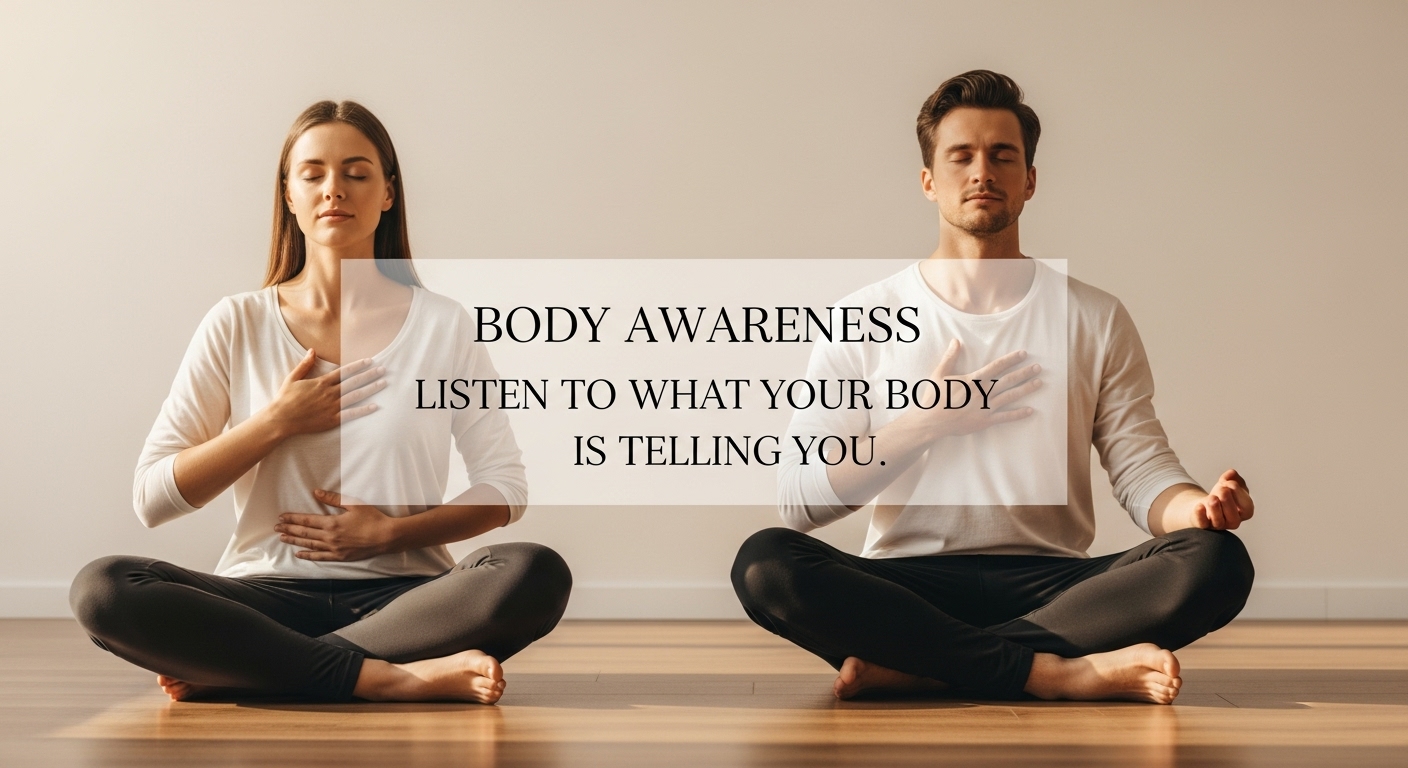
Start by just noticing without controlling. Put one hand on your tummy and the other on your chest. Which moves more? Most people who are chronically stressed breathe shallowly into their upper chest, which actually triggers more stress responses. Diaphragmatic breathing, where your belly expands on the inhale, activates your parasympathetic nervous system. This is body awareness in its most fundamental form.
Box breathing is a technique I use when I feel overwhelmed: inhale for four counts, hold for four, exhale for four, hold for four. Repeat. This pattern interrupts the stress cycle. What makes this a body & awareness practice rather than just a relaxation technique is that you’re simultaneously noticing how your body responds, where you feel the breath moving, where you encounter resistance.
The practice of breath focused body-awareness isn’t about breathing perfectly. It’s about developing sensitivity to your breath as a real time indicator of your internal state. When you can catch yourself holding your breath or hyperventilating through body & awareness, you’ve gained a powerful early warning system for stress and burnout.
Coherent breathing, where you breathe at a rate of five breaths per minute, has been shown to optimize heart rate variability. But beyond the physiological benefits, these awareness practices train you to maintain awareness of your respiratory state throughout the day.
Proven Approach Questions:
- What’s your default breathing pattern when you’re stressed versus relaxed?
- How often do you unconsciously hold your breath during the day?
- Can you identify the physical locations where your breath feels restricted?
Interoceptive Exercises for Advanced Sensory Awareness.
Interoception is your ability to sense internal bodily states like hunger, thirst, heart rate, and muscle tension. Most people with burnout have severely diminished interoceptive body awareness because they’ve learned to override these signals in pursuit of productivity.
One powerful body awareness exercise is the heartbeat detection task. Sit quietly and try to count your heartbeats for one minute without taking your pulse. Then check your actual heart rate and compare. Most people are wildly inaccurate at first, which reveals how disconnected they are from internal bodily processes. With practice, your awareness accuracy improves.
Temperature awareness exercises help you notice subtle shifts through body awareness. Sit quietly and scan for areas that feel warm versus cool. Notice if your hands are cold, if your face feels flushed, if your core temperature feels balanced. These sensations provide information about your autonomic state.
I practice hunger and satiety body awareness by rating my hunger on a scale of 1 to 10 before and after meals. This revealed that I often ate when I wasn’t actually hungry and continued eating well past the point of comfortable fullness. Body awareness means learning to distinguish physical hunger from emotional cravings.
Tension mapping is a body awareness exercise where you periodically pause and mentally note where you’re holding tension. I set reminders on my phone to do this every two hours. Initially, I found chronic tension in my jaw, shoulders, and lower back that I’d been completely unconscious of. Over time through body-awareness practice, I started catching these patterns earlier.
Proven Approach Questions:
- How accurately can you perceive internal states like heartbeat or hunger?
- What bodily sensations do you habitually override or ignore?
- Can you distinguish between physical needs and emotional responses?
Creating a Sustainable Body Awareness Practice.

Building sustainable body awareness requires consistency rather than intensity. The approach that finally stuck was micro practices integrated into existing routines rather than adding new time commitments.
Start your day with a two minute body awareness check in before you even get out of bed. Scan through your body and notice how you feel physically. This sets an intention to maintain body awareness throughout the day. I pair this with my morning coffee, which creates an automatic trigger.
Use transitions as body awareness opportunities. Before you start your car, take three conscious breaths and notice your physical state. Before entering a meeting, scan for tension. These transitional moments are perfect for micro body awareness practices because they’re already natural breaks in your routine.
Evening body awareness practices help process accumulated stress before it becomes chronic. I spend 5 to 10 minutes doing gentle stretches while mentally reviewing where I held tension during the day. This creates a feedback loop where I start recognizing patterns through body-awareness.
Track your body awareness progress without obsessing over it. I keep simple notes about what I notice during practices, but I don’t treat it like a performance metric. The goal is developing sensitivity and connection, not achieving some perfect state.
Remember that body awareness is a lifelong practice, not a problem to solve. There’s no finish line where you finally achieve perfect attunement. The practice itself is the point: continually returning to curiosity about your physical experience and gently bringing body awareness back to sensation.
Proven Approach Questions:
- What micro practices could you integrate into your existing daily routines?
- Which transitions in your day would benefit from awareness check ins?
- How can you track progress without creating performance pressure?
Conclusion.
Body awareness isn’t another wellness trend to add to your overwhelming list. It’s a fundamental skill that determines whether you’ll continue sleepwalking through life until burnout forces you to stop or whether you’ll develop the capacity to recognize early warning signs.
The five body-awareness approaches I’ve shared work together to rebuild the connection between your mind and body: body scanning, conscious movement, breathwork, interoceptive exercises, and sustainable daily practices. You don’t need to master all of them at once. Start with the body awareness technique that feels most accessible.
What I know for certain is this: the body keeps the score, whether you’re paying attention or not. You can either learn its language now through gentle body awareness, or you’ll be forced to learn it later when it speaks through pain or complete breakdown. Developing body awareness changed everything about how I move through the world.
Your body is not your enemy or a machine to be optimized. It’s your most reliable source of wisdom about what you truly need. Learning to listen through body awareness practices is perhaps the most important investment you can make in preventing burnout and reclaiming your life.
TOP 15 FAQ’s
-
What is the meaning of body awareness?
Body awareness means noticing your physical sensations, tension, and internal signals so you can respond before stress becomes burnout.
-
What causes poor body awareness?
Ignoring physical signals, chronic stress, rushing through tasks, and living on autopilot weaken your connection to your body.
-
What is the body awareness technique?
A body scan, slowly noticing sensations from head to toe helps you reconnect with tension, breath, and internal states.
-
What are the signs of body awareness?
You can sense tension, notice breath changes, detect stress early, and recognize when your body needs rest or adjustment.
-
Body awareness in Physical Education
It helps students understand posture, movement quality, balance, and how their bodies feel during activities.
-
Body awareness examples
Feeling shoulder tension, noticing shallow breath, sensing heartbeat changes, or recognizing tight hips during movement.
-
Body awareness activities
Body scans, mindful walking, slow yoga, breath observation, tension mapping, and controlled conscious movement.
-
Body Awareness Therapy
A therapeutic approach using movement, sensation awareness, and breathwork to improve mind–body connection.
-
Body awareness proprioception
This is your sense of where your body is in space, improved by mindful movement and tuning into muscular sensations.
-
Body Awareness play
Free, expressive movement that helps children or adults explore sensations, posture, and coordination naturally.
-
Body awareness benefits
Reduces stress, prevents burnout, improves emotional regulation, enhances movement quality, and boosts overall well-being.
-
What causes poor interoception?
Constant multitasking, suppressing physical needs, high stress, and ignoring internal states weaken internal sensing.
-
How do you improve somatic intelligence?
Use slow movement, breathwork, body scanning, and micro check-ins throughout the day to rebuild sensory awareness.
-
How do you practice conscious movement?
Move slowly, feel each joint and muscle, and pay attention to breath and tension instead of focusing on performance.
-
How do I build a sustainable body awareness habit?
Add tiny practices: morning check-ins, breath scans during breaks, tension mapping, and mindful transitions.