Functional core workout habits that improve balance and stability through mindful micro movements. Build core strength daily without intense routines or gym time.
Table of Contents
Introduction.
I used to think my core was strong because I could hold a plank for two minutes. Then one day, I stumbled on a completely flat sidewalk. My abs looked fine, but my body had no idea how to catch itself. That moment taught me something crucial: core strength without functional stability is like having a sports car with no steering wheel.
If you’ve ever felt unstable during a workout, experienced random back tightness, or wobbled when standing on one leg, you’re dealing with what I call the stability gap. Your muscles might be strong in isolation, but they haven’t learned to work together as a responsive system. A functional core workout isn’t about burning your abs until they scream. It’s about teaching your body to stabilize, adapt, and respond to real world movement with confidence.
This article will show you seven micro habits that rebuild core stability from the ground up. You’ll discover why a functional core workout focuses on awareness and consistency instead of intensity, and how balance becomes a skill you train through small daily cues rather than exhausting routines.
Understanding What a Functional Core Workout Trains.
A functional core workout trains your midsection to stabilize your spine and transfer force efficiently during movement, not just flex and extend during crunches.
Most people think core training means abs that show or exercises that burn. But when I started working with movement specialists, I realized my entire approach was backward. Your core isn’t just the six pack muscles on the front of your torso. It’s a complex system that includes your diaphragm at the top, your pelvic floor at the bottom, deep spinal stabilizers in the back, and obliques wrapping around your sides.
Traditional ab workouts build isolated strength. A functional core workout builds coordinated stability. The difference showed up when I lifted a heavy box from my car trunk and felt my lower back seize up. My trainer asked one question: “Were you breathing?” I wasn’t. I had braced, held my breath, and muscled through it. That’s when I learned that a functional core workout starts with breath linked activation, not just strength.
Think of your core like the building block of a home. You can have beautiful walls and a great roof, but if the foundation shifts and cracks, everything becomes unstable. Traditional ab workouts build the walls without reinforcing the foundation. A functional core workout rebuilds that foundation so every movement you make feels solid and connected.
Building balance into your workout.
Proven Approach Questions:
- When you stand on one leg, do you feel stable or immediately start compensating?
- Can you feel your deep core muscles engage, or do you only feel surface abs?
- During everyday movements like bending or reaching, does your body feel coordinated?
- When doing difficult motions, do you hold your breath?
- When you get tired, does your posture collapse?
Habit One: Building Your Functional Core Workout With Breath Work.

Breath linked core engagement activates your deep stabilizers automatically by coordinating your diaphragm and pelvic floor with every inhale and exhale.
For years, I treated breathing and core training as separate things. I’d do my ab exercises, then move on with my day. But a functional core workout lives in the connection between breath and muscle activation. When you inhale deeply, your diaphragm pushes down and your pelvic floor gently releases. When you exhale fully, your deep core muscles engage naturally to support your spine.
I started practicing this simple pattern while sitting at my desk. Inhale for four counts, feeling my belly and ribcage expand. Exhale for six counts, gently drawing my lower belly in and up. No forcing, no crunching, just coordinated breathing. Within two weeks, my lower back felt less achy after long work sessions. My body was learning to stabilize itself through breath, not bracing.
The beauty of adding breath work to your functional core workout is that you can practice anywhere: standing in line, sitting in traffic, lying in bed. You’re not adding another workout to your day. You’re reprogramming how your core responds to life. Start with five breath cycles, three times per day. Notice how your ribcage moves, how your belly responds, how your spine feels supported from the inside out.
Proven Approach Questions:
- Can you feel your ribcage expand in three dimensions, or does your breath stay shallow?
- Does your belly move freely as you breathe, or do you hold tension there?
- Can you exhale fully without collapsing your posture?
- Do you notice your pelvic floor gently engaging as you exhale?
- How does your lower back feel after breath focused practice?
Habit Two: Adding Balance Training to Your Functional Core Workout.
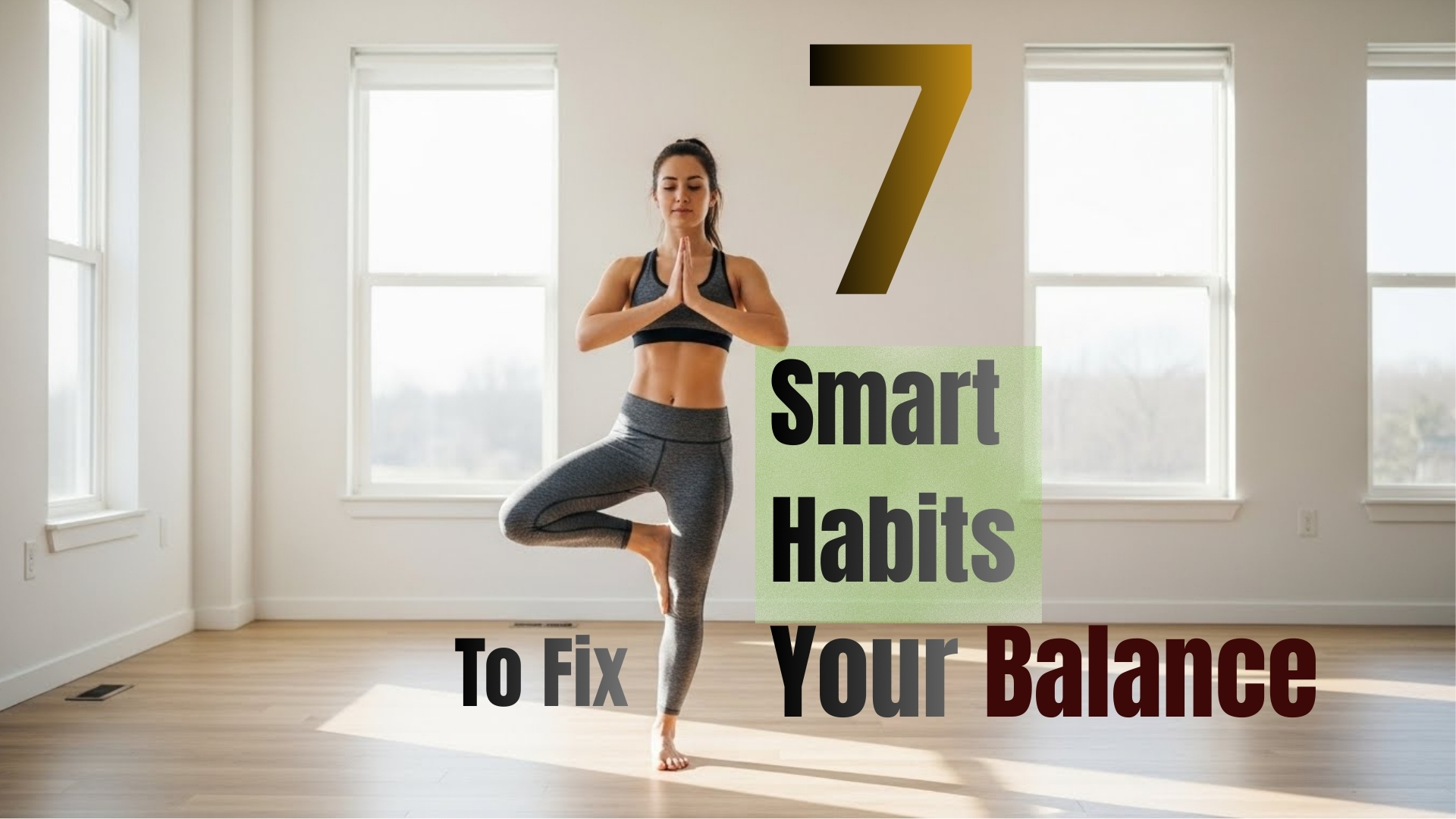
Standing balance work teaches your core to make micro adjustments constantly, building the reflexive stability you need for real world movement.
I used to skip balance exercises because they felt too easy. Stand on one leg for 30 seconds? What’s that going to do? But when I actually tried it mindfully during my functional core workout, I was humbled. My ankle wobbled, my hip hiked up, my arms flailed, and I could barely hold the position for 10 seconds.
Balance isn’t about standing perfectly still. It’s about training your core to respond to constant small disruptions. Every tiny shift in weight, every adjustment to stay upright, forces your deep stabilizers to fire in coordinated patterns. I started brushing my teeth on one leg each morning. Left leg while brushing the top teeth, right leg while brushing the bottom. Then I progressed to closing my eyes for the last 10 seconds.
Making balance work part of your functional core workout doesn’t require gym time. These weren’t separate workouts. They were moments woven into my existing routine. After a month, I felt more grounded during squats, more stable during lunges, and far more confident navigating uneven terrain. My core had learned to adapt, not just contract.
Proven Approach Questions:
- Can you stand on one leg for 30 seconds without holding onto something?
- What happens to your posture when you close your eyes during balance work?
- Do you feel your core actively working to keep you stable?
- Can you maintain steady breathing during balance challenges?
- How quickly can you recover when you start to lose balance?
Habit Three: Integrating Your Functional Core Workout Into Daily Movements.
Functional core activation during daily tasks turns ordinary moments into training opportunities that build real world stability.
The biggest breakthrough in my functional core workout didn’t happen in a gym. It happened when I started treating every movement as a chance to practice stability. Picking up my backpack, reaching for a coffee mug, bending to tie my shoes became micro workouts for my core. Before, I’d mindlessly reach and grab, often feeling a twinge in my lower back. Now I pause for half a second, exhale, engage my core, then move with intention.
This sounds tedious until you realize how many times per day you bend, reach, lift, or twist. If you consciously engage your core for even 10 of those moments, you’ve extended your functional core workout throughout your day without setting foot in a gym. I started with the kitchen. Every time I opened the fridge, I’d exhale and gently brace before pulling the door. Every time I unloaded the dishwasher, I’d hinge at my hips with a stable spine. My lower back stopped aching after meal prep.
The key to making daily movement part of your functional core workout is using cues, not chores. Pick one recurring activity: getting in and out of your car, lifting your laptop bag, standing up from your desk. For one week, activate your core intentionally during that single activity. Once it becomes automatic, add another. You’re not adding time, you’re adding awareness.
Proven Approach Questions:
- Do you feel your core engage before you lift something, or after you’re already moving?
- Can you hinge at your hips with a neutral spine, or does your back round?
- During twisting movements like reaching behind you, does your core stabilize your spine?
- How often do you move reactively versus moving with intention?
- After a full day of mindful activation, does your body feel more or less fatigued?
Read previous article on
“How to Build Mental Strength Through Powerful Inner Dialogue“
Habit Four: Using Anti Movement Patterns in Your Functional Core Workout.
Anti movement exercises teach your core to resist unwanted motion, which is exactly what it needs to do during functional activities.
I used to think core training meant making my torso move: crunches, sit ups, Russian twists. Then a physical therapist told me something that changed my functional core workout approach: “Your core’s main job isn’t to create movement. It’s to prevent it.” That’s when I discovered anti movement patterns like planks, dead bugs, and pallof presses.
A proper plank isn’t about how long you hold it. It’s about maintaining perfect alignment while breathing normally. I dropped my plank hold from two minutes to 30 seconds, but focused on quality: shoulders stacked over elbows, ribs drawn in, pelvis neutral, breathing steady. That 30 seconds felt harder than my old two minute sag fest, and the carryover to real life was immediate. Carrying grocery bags felt easier because my core knew how to resist side bending.
When structuring your functional core workout, include three anti movement patterns: a plank variation to resist extension, a side plank to resist lateral flexion, and a bird dog to resist rotation. Do just one set of each, focusing entirely on maintaining perfect position and steady breathing. Your core will learn that stability, not exhaustion, is the goal.
Proven Approach Questions:
- Can you hold a plank with perfect form for 20 seconds, or does your position break down?
- During a side plank, does your hip drop, or can you maintain a straight line?
- When you extend one arm and opposite leg during bird dog, does your spine stay neutral?
- Can you breathe normally during anti movement exercises, or do you brace?
- How does your posture feel after practicing anti movement patterns?
Habit Five: Ground Based Movement in Your Functional Core Workout.
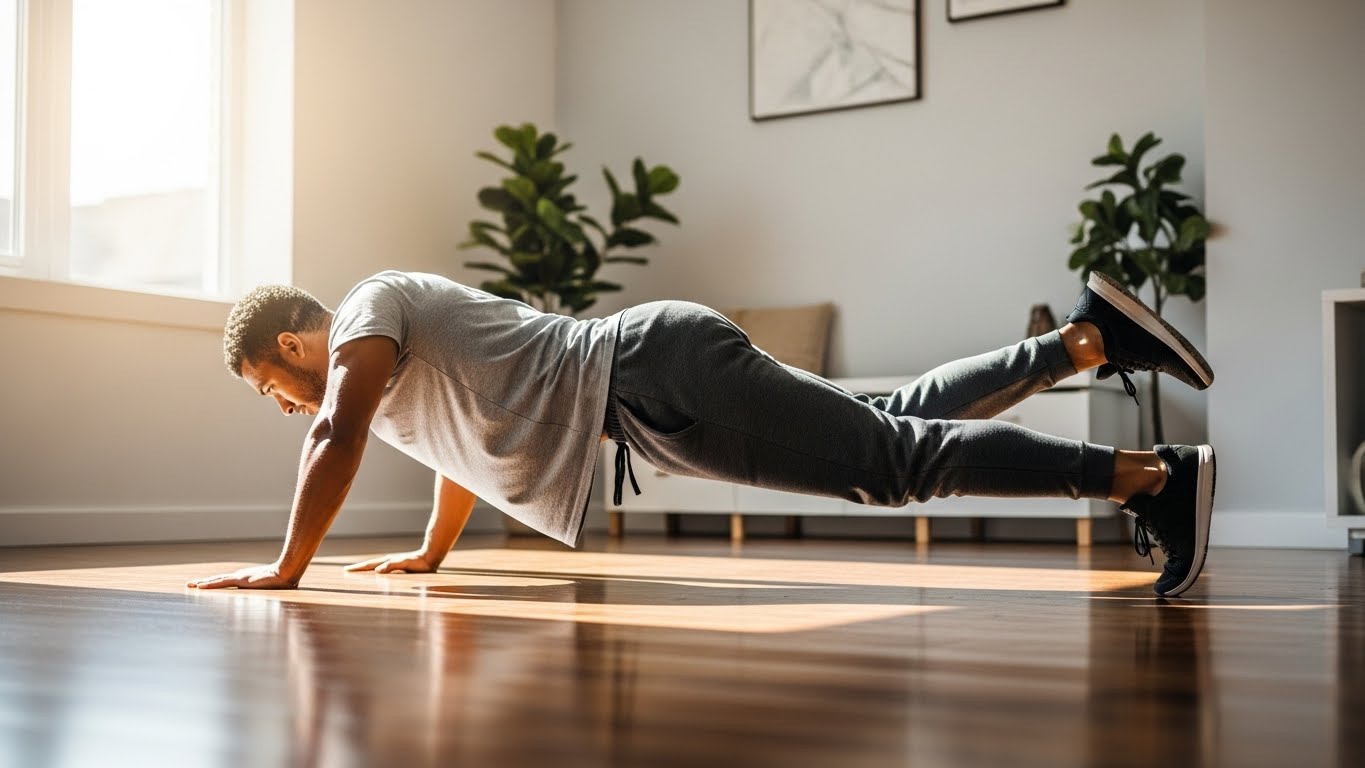
Ground based movements like rolling, crawling, and floor transitions rebuild primal core coordination and body awareness.
Somewhere between childhood and adulthood, most of us lose our connection to the ground. We sit in chairs, stand upright, and rarely explore the space in between. But some of the richest elements of a functional core workout happen when you get down on the floor. I started experimenting with simple floor transitions: lying down without using my hands, rolling from my back to my stomach, getting up from seated using different pathways.
Crawling brought everything together in my functional core workout. Not baby crawling, but contralateral crawling where opposite hand and knee move together while your torso stays stable. It looks simple, but it demands intense core coordination to keep your hips level and spine neutral. I crawled forward and backward for just two minutes, three times per week. My shoulders felt more stable, my hips more mobile, and my core more integrated.
Adding ground work to your functional core workout doesn’t require a formal routine. Just spend five minutes on the floor before or after your regular training. Practice rolling smoothly from side to side. Try a slow bear crawl across your living room. Experiment with different ways to stand up from sitting. Your core will learn to coordinate movement in three dimensions.
Proven Approach Questions:
- Can you lie down and stand up without using your hands or excessive momentum?
- When you roll from back to stomach, does the movement feel smooth or choppy?
- During crawling patterns, does your torso stay stable, or does your back sag?
- How aware are you of your core working during ground movement versus traditional exercises?
- Does your body feel more coordinated after floor based training?
Habit Six: Closed Eye Training in Your Functional Core Workout.
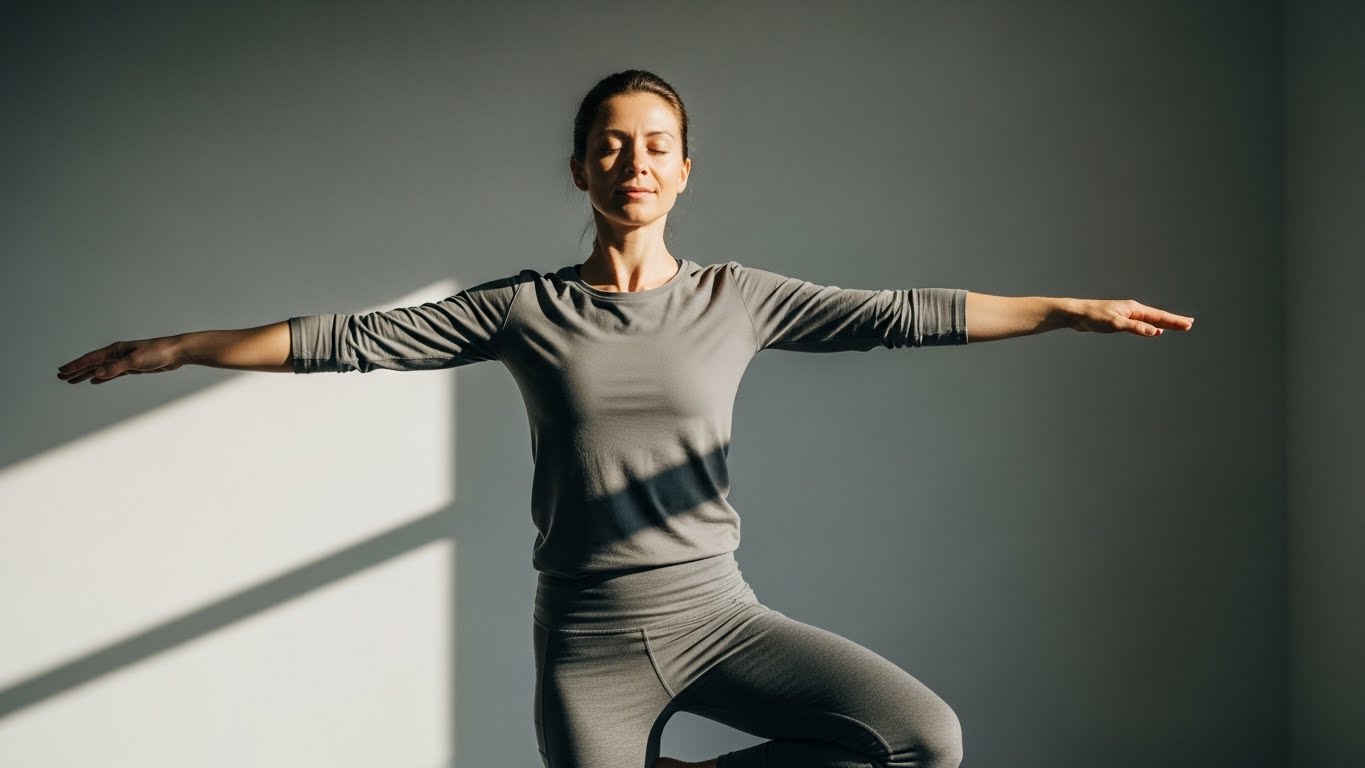
Removing visual input forces your core and nervous system to rely on proprioception, dramatically improving your body’s internal awareness.
I discovered the power of adding closed eye work to my functional core workout by accident. I was doing single leg balance, got bored, and closed my eyes. I immediately fell over. With eyes open, I could compensate using visual cues. With eyes closed, my core had to rely entirely on internal feedback from muscles and joints. That’s proprioception: your body’s ability to sense where it is in space without looking.
Proprioceptive training transforms your functional core workout because it teaches stabilizers to respond to internal signals, not external ones. I started closing my eyes during the last 10 seconds of every balance exercise. Then I tried it during slow marching in place. Then during gentle reaches. Each progression challenged my core to work harder and smarter.
Start conservatively when adding this to your functional core workout. Close your eyes while standing on both feet, feeling how your body makes tiny adjustments. Progress to standing on one foot with eyes closed near a wall. The goal isn’t to never wobble. The goal is to train your core to respond automatically.
Proven Approach Questions:
- What happens to your balance when you close your eyes during standing exercises?
- Can you feel your core making micro adjustments to keep you stable?
- How long can you maintain balance with eyes closed compared to eyes open?
- Does closing your eyes increase your awareness of tension patterns?
- After practicing closed eye work, do everyday movements feel more controlled?
Habit Seven: Recovery as Part of Your Functional Core Workout.
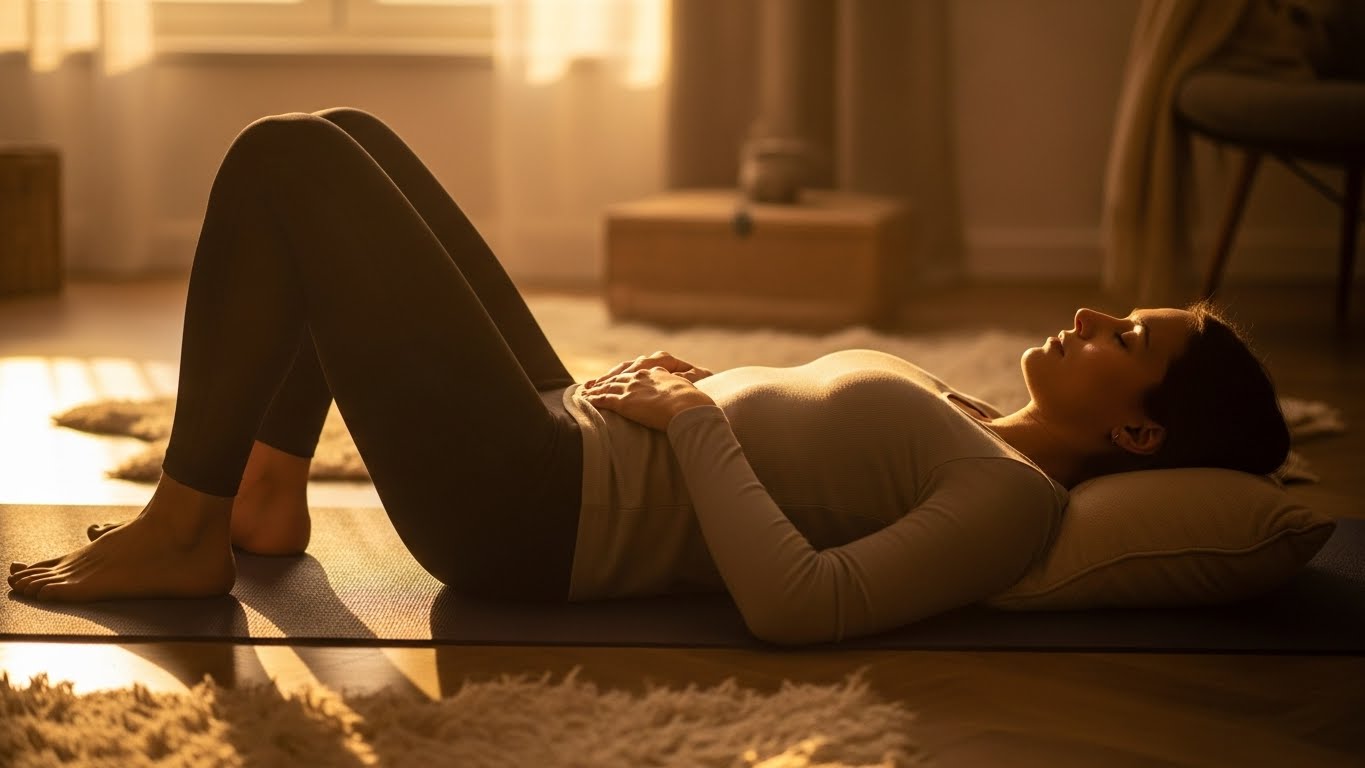
Functional core stability improves faster when your nervous system is regulated, not stressed, making recovery habits as important as training.
This was the hardest lesson for me to learn about building an effective functional core workout. I kept adding more exercises, trying harder, pushing longer, wondering why my balance wasn’t improving. Then a coach asked me how I was sleeping, how stressed I felt, how much downtime I was taking. Poorly, very, and none. Your core stability is neurological, not just muscular.
I started treating recovery as part of my functional core workout. I added 10 minutes of gentle stretching and breathing before bed. I took one full rest day per week with no structured exercise. I practiced five minute body scans where I’d lie down, breathe deeply, and consciously relax every muscle. My balance improved faster, my movements felt smoother, and exercises that used to feel shaky suddenly felt solid.
Your functional core workout works best when your nervous system feels safe. If you’re chronically stressed, your body defaults to protective tension patterns that override stability. Give yourself permission to do less and recover more. Your core will thank you with better performance.
Proven Approach Questions:
- Do you feel more stable after a good night’s sleep or after poor sleep?
- Can you identify tension patterns affecting your core stability?
- How often do you incorporate genuine rest into your training?
- Does your balance training feel like another stressor, or does it feel centering?
- When you prioritize recovery, do you notice improvements in stability?
Conclusion.
A functional core workout isn’t built in the gym through intense ab burning sessions. It’s built through consistent, mindful habits that teach your body to stabilize and adapt with confidence. These seven smart habits retrain your core as an integrated system: breath linked engagement creates the foundation, balance challenges build reflexive stability, everyday movement activation turns life into training, anti movement patterns develop control, ground based movement rebuilds coordination, closed eye exercises enhance proprioception, and recovery allows integration.
Start with one habit this week. Choose the one that addresses your biggest frustration. Practice it daily, not perfectly. As it becomes automatic, layer in another. Within a month, you’ll notice your body moving differently: more stable during workouts, more confident on uneven ground, more resilient against random strains. You’re not just building a stronger core through your functional core workout. You’re building a smarter one that knows how to keep you balanced and safe in the unpredictable reality of human movement.
Top 15 FAQ’s People Also Ask on Google !
-
What is a functional core exercise?
A functional core exercise trains your core to stabilize the spine and control movement during real-life tasks, not just flex the abs.
-
What are the 4 types of core exercises?
They include stability, anti-movement, balance-based, and integrated movement exercises that teach the core to resist and transfer force.
-
Can I do functional core exercises everyday?
Yes. Functional core work uses low-intensity micro movements that improve stability daily without overloading muscles.
-
Can beginners do functional core exercises?
Absolutely. Functional core workouts start with breath, balance, and awareness, making them ideal for beginners.
-
Functional core workout plan pdf.
A functional core plan focuses on daily habits like breathwork, balance drills, and ground movements rather than long gym sessions.
-
Functional core workout pdf.
Most functional core routines are habit-based and don’t require structured PDFs, just consistent mindful movement practice.
-
Functional core workout for beginners.
Beginners benefit most from breath-linked activation, single-leg balance, and slow anti-movement exercises.
-
Functional core workout standing.
Standing core workouts improve balance and real-world stability by training the core to react against gravity.
-
Functional core workout with weights.
Weights can be used if they challenge stability, such as carries or anti-rotation holds, not isolation ab work.
-
Functional core workout kettlebell.
Kettlebells enhance functional core strength through carries, slow hinges, and controlled anti-rotation patterns.
-
Core workout Gym Female.
A functional core workout helps women improve posture, balance, and spinal stability without high-impact ab training.
-
Is a functional core better than crunches?
Yes. Functional core training builds stability and coordination, while crunches only strengthen surface muscles.
-
How long does it take to build functional core strength?
Most people notice better balance and control within 3–4 weeks of daily mindful practice.
-
Does balance training really strengthen the core?
Yes. Balance challenges force constant core engagement through reflexive micro-adjustments.
-
Why does recovery matter for core stability?
Core stability is neurological. Recovery calms the nervous system, allowing better coordination and balance.