
Unlock mind clarity with 7 rare weightlifting secrets for peak performance. Transform your mental focus through proven physical training techniques that elite athletes use.
Introduction
Remember the stress management breakthroughs we discovered in “Stress Management Journal: 7 Bold Ways to Unlock Growth”? Those journaling techniques were just the beginning of our Mind-Body Integration journey.
Ever felt like your mind was running a marathon while your body sat still? I’ve been there too many times to count, especially after implementing those bold stress management strategies but still feeling like something was missing from the complete picture.
Here’s a shocking stat that changed everything for me: neuroscientists discovered that weightlifting creates new neural pathways in just 6 weeks, literally rewiring your brain for better mind clarity and decision making. When I first heard this, I was skeptical. How could picking up heavy things possibly clear the mental fog that even our proven stress management journal techniques couldn’t fully eliminate ?
But here’s what happened when I started treating my workouts as mind training sessions instead of just muscle building. My focus sharpened like a laser. Those afternoon brain crashes? Gone. The endless loop of overthinking that kept me up at night? Significantly reduced. The stress patterns I’d been tracking and managing through journaling suddenly had a powerful physical solution.
Mind clarity isn’t just about meditation and journaling anymore. It’s about understanding how your physical body serves as the foundation for mental performance. If you’ve been following along with our stress management journal approach, today I’m sharing 7 rare weightlifting secrets that most people never connect to enhancing mind clarity.
By the end of this article, you’ll have a blueprint for using resistance training to unlock levels of mind clarity you didn’t know existed. These mind clarity techniques will transform your mental performance and perfectly complement the stress management foundation we built together.
The Science Behind Physical Training and Mind Clarity.

Look, I used to think the gym was just about looking good in a tank top. Boy, was I missing the bigger picture.
When you lift weights, your brain releases BDNF (brain derived neurotrophic factor) basically miracle grow for your neurons. This protein doesn’t just help with mind clarity; it literally builds new brain cells and strengthens existing connections. Studies show that resistance training increases executive function by 15-20% within 8 weeks.
The stress you put on your muscles during lifting creates a hormonal cascade that includes increased dopamine and norepinephrine production. These are the neurotransmitters responsible for focus, motivation and clear thinking.
You know that feeling when you’re in the middle of a tough set and suddenly everything else fades away? That’s flow state, and it’s the same mental space where breakthrough ideas happen. I’ve solved more work problems during my rest periods between squats than sitting at my desk overthinking them.
The mind-body connection isn’t just philosophical, it’s neurological, and every rep you complete is literally sculpting a sharper, clearer mind.
Mind Clarity Secret 1: The Neurological Reset Technique.
Between every set, instead of scrolling my phone, I spend 30 seconds doing what I call “the reset.” I close my eyes, take three deep breaths, and mentally scan my body from head to toe.
Here’s why this works: when you’re lifting heavy, your nervous system gets amped up. The reset technique activates your parasympathetic nervous system, which is like hitting the refresh button on your brain. I learned this from a powerlifter who competed at nationals.
I started implementing this during a particularly stressful period when my mind felt scattered all day. Within two weeks, I noticed something incredible. My thoughts became more organized. Decision making felt easier. That constant background anxiety started fading.
The beauty of this method is it trains your brain to shift gears quickly. In life, we’re constantly switching between high stress situations and moments that require calm thinking.
I used to struggle with decision paralysis, every choice felt overwhelming, and I’d second guess myself constantly. The scattered thoughts would bounce around my head like ping-pong balls. But learning to reset between sets taught me something profound about managing mental chaos. When you’re forced to calm your nervous system between heavy lifts, you’re literally practicing emotional regulation under pressure. The same skill that helps you nail your next set helps you think clearly during stressful meetings.
Life, like lifting, requires moments of intense focus followed by complete relaxation mastering the transition is where mind clarity lives.
Mind Clarity Secret 2: Tempo Manipulation for Cognitive Control.
Nobody talks about lifting tempo anymore, and that’s a massive mistake for anyone seeking mind clarity.
I discovered this during a period when I was dealing with severe decision paralysis at work. Instead of my usual quick reps, we started with 4-second negatives on every exercise. Four seconds to lower the weight, pause, then explode up.
What happened next blew my mind. The forced slowness in my workouts started translating to better decision making outside the gym. When you’re forced to control a 200 pound squat for 4 seconds on the way down, your brain learns patience and precision.
Slow, controlled movements require enhanced proprioception your brain’s awareness of body position in space. This heightened body awareness strengthens the same neural networks responsible for self awareness and emotional regulation.
Now I use specific tempos for different mental states. Need more focus for an important presentation? I’ll do slow, controlled movements. Want to build confidence for a difficult conversation? Explosive, powerful reps.
The deeper connection hit me when I realized my racing thoughts matched my hasty movement patterns. I was always rushing through workouts, through decisions, through conversations. This constant mental speed created anxiety and clouded my thinking. When I learned to control the speed of my lifts, I discovered I could control the speed of my thoughts too. Tempo training became my meditation in motion.
When you learn to control the speed of your body, you develop the ability to control the speed of your thoughts.
Mind Clarity Secret 3: Unilateral Training and Mental Balance.

Here’s something that changed my entire perspective on mind clarity: training one side of your body at a time.
Most people stick to bilateral movements squats, bench press, deadlifts. Both sides working together. Safe. Comfortable. But when you perform a single arm dumbbell press, something incredible happens in your brain. The working side has to communicate more intensely with your core and opposite leg for stability.
This cross lateral communication strengthens the corpus callosum the bridge between your brain’s left and right hemispheres.
I first noticed this during a challenging project where I kept getting stuck in rigid thinking patterns. My solutions were always the same, predictable, and boring. Then I started dedicating one day per week to unilateral training.
Single leg Romanian deadlifts. One-arm farmer’s walks. Split squats. These exercises demand balance, coordination, and constant micro adjustments. Your brain can’t go on autopilot.
Within a month, colleagues started commenting on my creativity in problem solving. I was approaching challenges from angles I’d never considered before.
Just like I was struggling with overthinking and getting stuck in mental loops, I was also favoring my dominant side in every exercise. My right side was strong, my left side was weak. This physical imbalance was mirroring my mental imbalance relying too heavily on analytical thinking while neglecting intuitive insights. When I started training both sides equally, my mind began accessing both logical and creative solutions to problems.
Training both sides of your body equally teaches your mind to consider multiple perspectives instead of getting trapped in one-sided thinking.
Mind Clarity Secret 4: Progressive Overload for Mental Resilience.
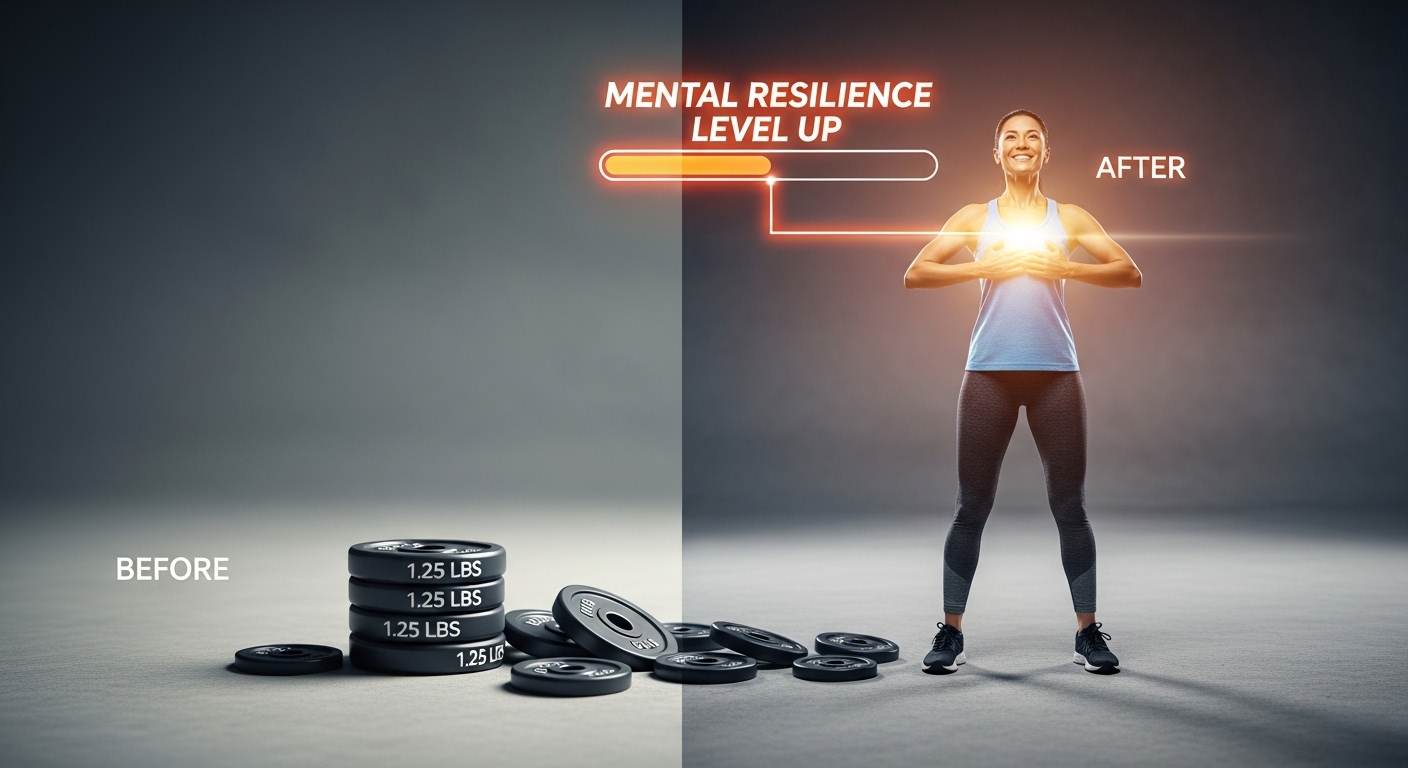
Progressive overload isn’t just about adding weight to the bar it’s about systematically expanding your comfort zone, and this principle transforms mind clarity like nothing else.
Most people misunderstand progressive overload. They think it means adding 5 pounds every week until you’re benching cars. That’s not sustainable, and it’s not how the brain develops resilience either.
I learned the real secret during a period when I was dealing with massive anxiety about taking on bigger projects at work. Every opportunity felt overwhelming. My trainer introduced me to microgradients tiny increases in difficulty that your nervous system barely notices.
Instead of jumping from 135 to 140 pounds on bench press, we’d add 1.25 pounds. Sometimes just holding the same weight for 5 more seconds.
The magic happens when you realize your brain adapts to stress the same way your muscles do. Small, consistent challenges build confidence without triggering the overwhelm response that shuts down clear thinking.
I started applying this principle to my mental challenges too. Instead of avoiding the big scary project, I’d break it into micro steps. Before I knew it, I was handling projects that used to terrify me.
Every time you successfully complete a lift that was challenging last week, your brain releases a victory hormone cocktail. This biochemical reward teaches your nervous system that challenge equals growth, not threat. I remember the day I finally hit a bodyweight squat after months of gradual progression. The real win was realizing that my mind had stopped fearing difficulty.
Mental resilience isn’t built through dramatic transformations it’s forged through countless small victories that teach your brain you can handle more than you think.
Secret 5: Compound Movement Coordination.
Compound movements changed how my brain processes complexity and I didn’t see it coming.
When I first started lifting, I was all about isolation exercises. Bicep curls, leg extensions, chest flies. Each muscle working alone, nice and simple. My approach to life problems was the same tackle one thing at a time, keep everything separate.
Then I discovered deadlifts. A proper deadlift requires your hamstrings, glutes, core, lats, traps, and grip to work together in perfect harmony. Your brain has to coordinate multiple muscle groups while maintaining spine position and bar path.
The first few months were humbling. My body parts wanted to work independently, just like my brain preferred to handle one problem at a time. But something remarkable happened as I progressed.
I started seeing connections everywhere. Work projects that seemed unrelated suddenly had obvious links. Personal habits I thought were separate issues were actually part of the same system.
Compound movements strengthen interhemispheric communication in your brain. The planning required for complex movements enhances your prefrontal cortex the area responsible for executive function and systems thinking.
I used to feel overwhelmed when life got complicated because I was trying to handle everything in isolation. Work stress, relationship issues, health concerns all separate problems requiring separate solutions. Compound movement training taught me that complexity isn’t chaotic; it’s just multiple simple systems working together. The day I realized I could approach my cluttered life like a deadlift finding the key movement pattern that organizes all the chaos everything clicked.
Life, like compound movements, requires all your systems to work together trying to solve problems separately is like doing bicep curls when you need to deadlift.
Secret 6: Breathing Patterns and State Control.

Nobody taught me how to breathe properly, and it was sabotaging both my lifts and my mind clarity.
I thought breathing was automatic you know, one of those things your body just handles while you focus on important stuff. Then I started paying attention to my breath during heavy squats and discovered I was holding my breath for entire sets.
Here’s what changed everything: learning that your breathing pattern directly controls your nervous system state. Short, shallow breaths trigger stress response. Long, controlled breaths activate recovery mode.
The technique I use now is called “powerlifting breathing.” Before I unrack the weight, I take three deep breaths 4 seconds in, 6 seconds out. This primes my nervous system for focus. During the lift, I hold my breath to create internal pressure. Between reps, I use that same 4-6 breathing pattern to reset.
What blew my mind was realizing this pattern was exactly what I needed for mind clarity in high stress situations. Big presentation coming up? 4-6 breathing before I walk in. Difficult conversation ahead? Same pattern.
When I was stressed and overwhelmed, my breathing became erratic and shallow, just like when I was struggling with a heavy lift. Both situations triggered the same fight or flight response that clouds thinking and impairs performance. Learning to control my breath during physical stress taught my nervous system that I could stay calm and clear headed even when things got challenging.
Your breath is the remote control for your nervous system, master it in the gym, and you master it everywhere.
Mind Clarity Secret 7: Recovery Periodization.
The biggest mind clarity breakthrough came when I finally understood that recovery isn’t the absence of training, it’s a skill that requires just as much attention as the work itself.
For years, I treated rest days like failures. If I wasn’t lifting, I wasn’t improving. My approach to mental work was identical, always grinding, always pushing, never truly recovering.
Everything changed when I learned about periodization from an Olympic lifting coach. Elite athletes don’t just plan their training; they plan their recovery with equal precision. Active recovery days, deload weeks, complete rest phases, all strategically designed to allow adaptations to occur.
I started applying this to my mental energy the same way. Instead of working until my brain turned to mush, I began scheduling recovery periods. Light movement on rest days. Reduced intensity weeks every month.
The results were incredible. My mind clarity didn’t just improve during work periods; it improved consistently because I was actually allowing my nervous system to adapt and strengthen.
I had been using constant busyness to avoid dealing with deeper feelings of inadequacy. If I was always working, always training, I didn’t have to face uncomfortable questions about whether I was actually making progress. Recovery forced me to sit with those feelings. At first, it was uncomfortable as hell. But gradually, I realized that the mind clarity I was seeking wasn’t found in more activity, it was found in the space between activities.
True strength, physical and mental , is built not just in the work, but in the wisdom to know when to rest.
Conclusion: Your Mental Transformation Blueprint.
Mind clarity isn’t a destination you reach and then coast. It’s a practice you develop through the systematic application of physical principles to mental challenges.
These 7 secrets work because they address the fundamental truth that your body and mind are not separate entities competing for your attention, they’re integrated systems designed to support each other. When you train your body with intention and awareness, you simultaneously train your mind to operate with greater precision and mind clarity.
Start with just one technique that resonates with you. Maybe it’s the neurological reset between sets, or perhaps the breathing patterns speak to your current stress levels. Master one approach completely before adding another. Each technique builds upon the others to create comprehensive mind clarity.
Remember, every rep you perform with conscious intention is simultaneously strengthening your muscles and sharpening your mind. The gym becomes your laboratory for developing not just physical strength, but the mental resilience and mind clarity that excellence in any field requires.
Your next workout isn’t just about building muscle or burning calories. It’s your next opportunity to forge the unbreakable mind clarity that transforms every other area of your life. These weightlifting secrets are your pathway to sustained mind clarity.
Top 15 Most FAQ’s
1. How quickly can I see improvements in mind clarity from weightlifting?
Most people notice initial mind clarity improvements within 2-3 weeks of consistent training. However, the neurological changes that create lasting mind clarity typically develop over 6-8 weeks, which is when new neural pathways become established.
2. Do I need to lift heavy weights to get mind clarity benefits?
No! Mind clarity benefits come from controlled, intentional movement rather than heavy loads. Start with weights that allow you to focus on proper form and the neurological reset technique. Progressive overload means gradually increasing difficulty, not jumping to maximum weights.
3. Can I practice the neurological reset technique outside the gym?
Absolutely! The 30-second reset (close eyes, three deep breaths, body scan) works anywhere. Use it between work tasks, before important meetings, or whenever you feel mentally scattered. It’s particularly effective during stressful situations.
4. What’s the difference between regular breathing and powerlifting breathing for mind clarity?
Regular breathing often becomes shallow and erratic under stress. Powerlifting breathing (4 seconds in, 6 seconds out) deliberately activates your parasympathetic nervous system, creating immediate mind clarity and nervous system control.
5. How does unilateral training compare to bilateral exercises for mental benefits?
Unilateral training forces greater brain hemisphere communication and prevents mental autopilot. While bilateral exercises are important for strength, single-sided movements specifically enhance creativity, problem-solving, and mental flexibility – key components of mind clarity.
6. Can beginners use these mind clarity techniques, or are they for advanced lifters?
These techniques are actually more beneficial for beginners! New lifters can establish mind-body connection patterns from the start, while advanced lifters often need to unlearn autopilot habits. Start with bodyweight or light resistance and focus on the mental aspects.
7. How long should I rest between sets to maximize mind clarity benefits?
60-90 seconds is optimal for mind clarity. This gives enough time for the neurological reset technique (30 seconds) plus physical recovery. Longer rests can cause mental drift, shorter rests don’t allow nervous system regulation.
8. What if I don’t have access to a gym? Can I still develop mind clarity through exercise?
Yes! Bodyweight exercises like single-leg squats, push-up variations, and unilateral movements work perfectly. The key is intentional movement with proper breathing and mental focus, not expensive equipment.
9. How does tempo manipulation work for different mental states?
Slow, controlled movements (4-second negatives) enhance patience and reduce anxiety. Explosive movements build confidence and decision-making speed. Match your tempo to the mental state you want to develop – it’s like programming your nervous system.
10. Can these techniques help with work-related stress and decision fatigue?
Absolutely! The mind clarity developed through these techniques directly transfers to work performance. Many people report better focus during meetings, clearer decision-making, and reduced afternoon mental fatigue after implementing these methods.
11. How often should I train for optimal mind clarity benefits?
3-4 sessions per week is ideal. This allows for both training stimulus and recovery periods. Remember, recovery periodization is crucial – your mind clarity actually develops during rest periods between sessions.
12. What’s the connection between compound movements and complex problem-solving?
Compound movements require your brain to coordinate multiple systems simultaneously, strengthening the same neural networks used for systems thinking and complex problem solving. Regular deadlifts literally make you better at seeing connections between seemingly unrelated problems.
13. Can I combine these techniques with meditation or other mindfulness practices?
Yes! These techniques complement meditation perfectly. In fact, many people find weightlifting with these principles becomes a form of moving meditation. The physical component often makes mindfulness more accessible for people who struggle with traditional meditation.
14. What should I do if I feel overwhelmed trying to implement all 7 secrets at once?
Start with just one technique, preferably the neurological reset or breathing patterns. Master one completely before adding another. Mental clarity develops through consistent practice of simple techniques, not overwhelming complexity.
15. How do I know if these techniques are working for my mind clarity?
Track your mental energy levels, decision-making confidence, and afternoon focus. Many people notice they stop reaching for caffeine in the afternoon, feel more decisive in meetings, and experience less mental chatter at night. Keep a simple journal to track these changes.