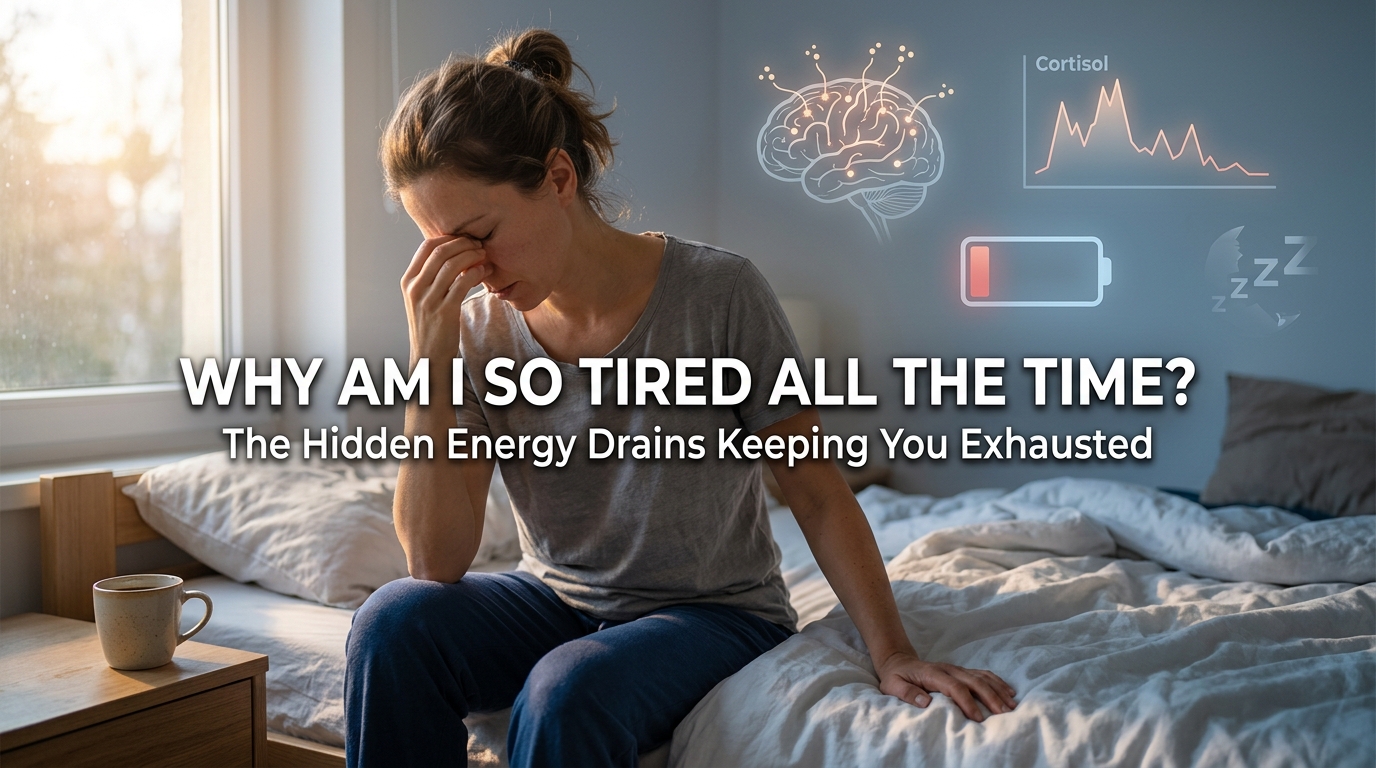
Why am I so tired all the time? Learn the true physiological and psychological reasons why your energy is being depleted every day, as well as practical solutions.
Table of Contents
You wake up after eight hours of sleep and still feel like you haven’t slept at all. You get through the morning on coffee, hit a wall by 2 PM, and by evening you’re running on nothing but somehow you can’t fall asleep easily either. This isn’t laziness. This isn’t just a busy schedule. Something is quietly draining your system, and until you identify what it is, no amount of rest will fix it.
So why am I so tired all the time? The direct answer: chronic fatigue isn’t usually caused by one thing it’s the result of compounding energy drains operating simultaneously. Your sleep might be fine. Your nutrition might be decent. But if your mental load, physical recovery, stress hormones, and daily habits are all pulling energy in the wrong direction at once, your body runs a permanent deficit that rest alone can’t close. People who ask why am I so tired every single day are usually dealing with a stacked problem, not a single missing fix.What “Always Being Tired” Actually Means.
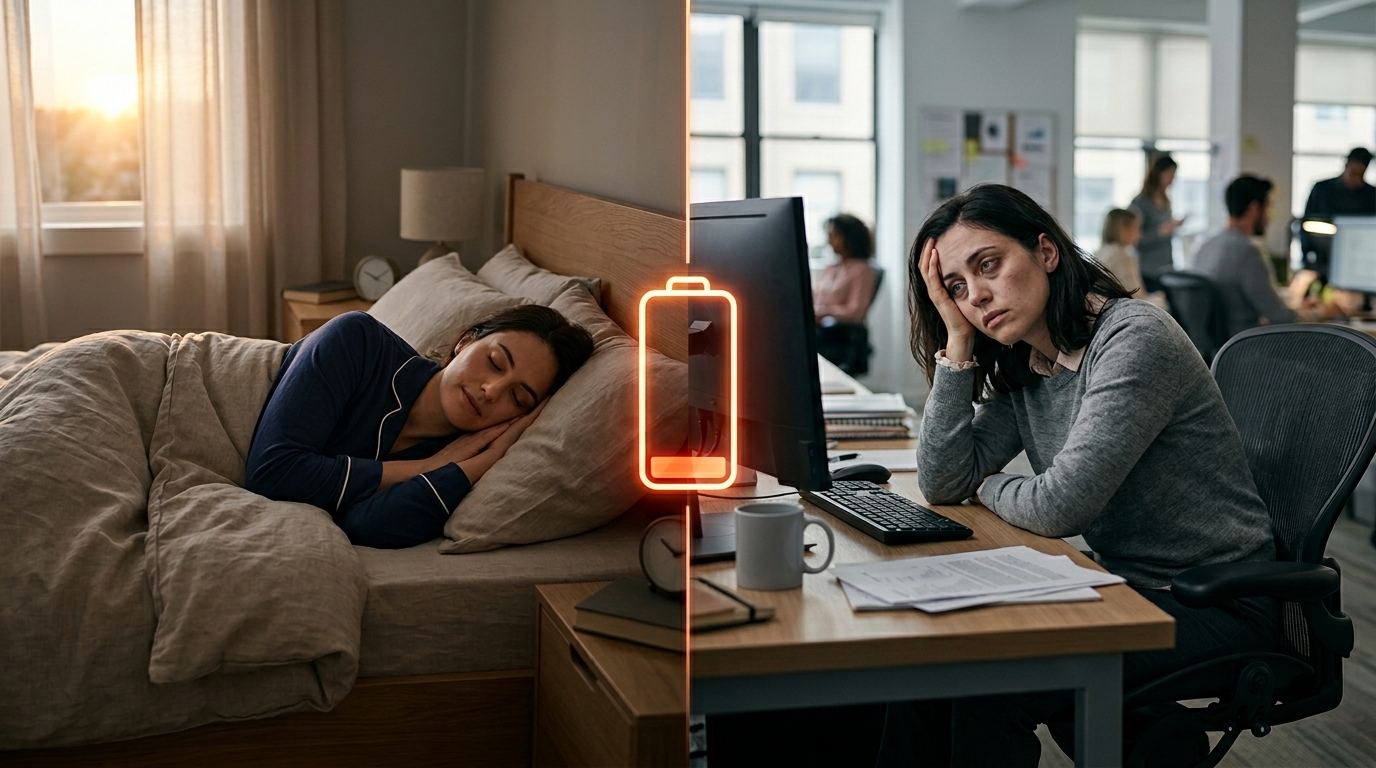
Tiredness and fatigue get used interchangeably, but they’re not the same thing. Tiredness is a signal your body asking for rest. Fatigue is a state your system running below functional capacity regardless of how much rest you get.
What chronic fatigue actually means: it’s a persistent gap between the energy your body and brain are producing and the energy your daily life demands. It’s not fixed by a single good night’s sleep because the gap itself is being constantly recreated by the same habits, stressors, and physiological patterns you return to every single day.
This distinction matters because it changes how you solve it. When you keep asking why am I so tired despite sleeping, the answer isn’t more hours in bed it’s closing the gap between what drains you and what restores you. You don’t treat fatigue by sleeping more. You treat it by closing the gap.
Your Brain Is Spending Energy You Don’t Know About.

The most overlooked energy drain isn’t physical it’s cognitive. Every unresolved decision, every background worry, every task sitting on a mental list you haven’t dealt with is consuming processing capacity. Neuroscientist Antonio Damasio’s work on somatic markers shows that the brain continuously evaluates emotional and contextual signals even when you’re not consciously thinking about a problem. That background processing has a real metabolic cost.
Mental fatigue reduces physical output by as much as 20% even when your muscles still have capacity.
Think about what happens on a heavy training day after a brutal week at work. Your legs aren’t the problem. Your squat numbers drop because your central nervous system is already taxed. The gym just reveals what your brain was already carrying. This is why so many people ask why am I so tired after work the answer is that your cognitive system burned through its reserves hours before you left the office.
This is the mind-body connection that most fatigue conversations ignore. Your physical energy is not separate from your mental state they run on the same system. When one is depleted, the other underperforms. If you’re wondering why you’re mentally exhausted, the solution has to do with both your body and your brain.
The Energy Leak Cycle: Why the Drain Keeps Repeating.
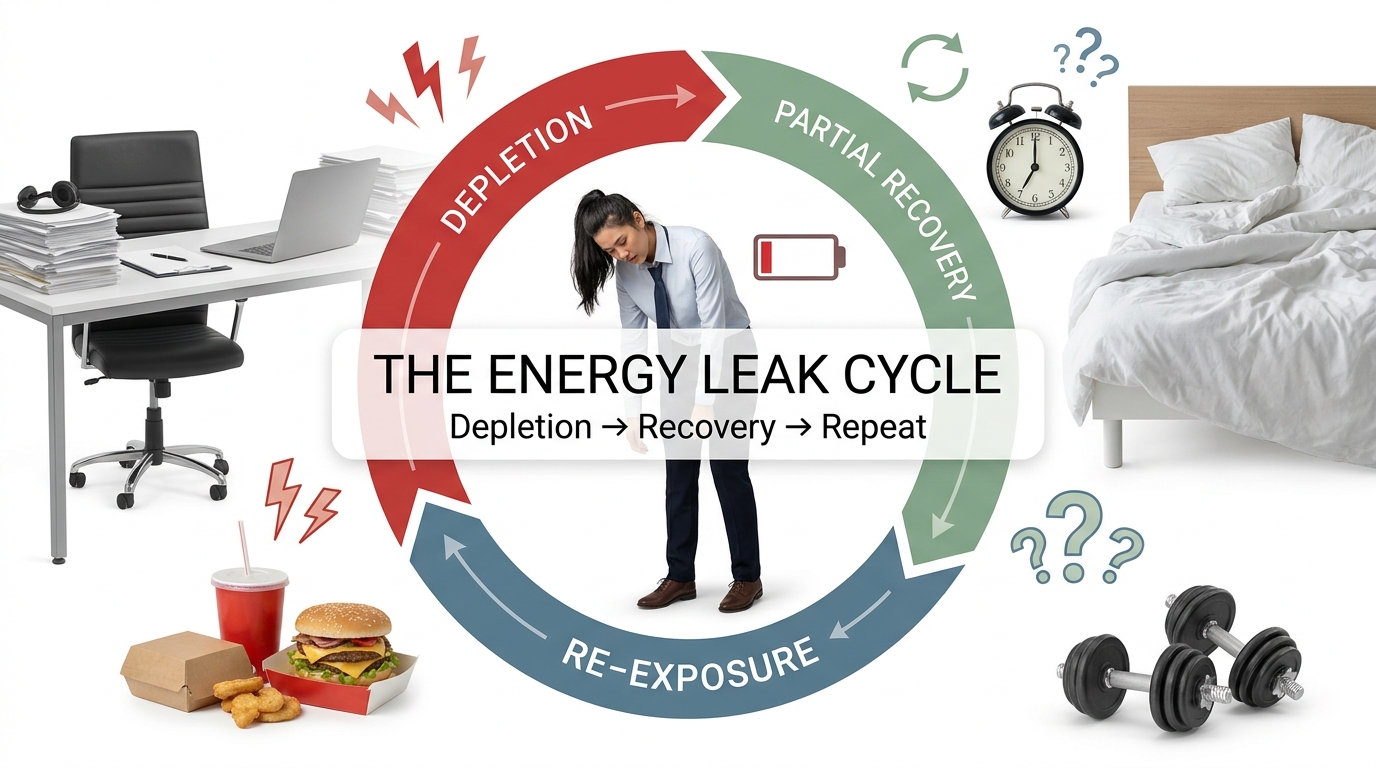
Most people try to solve fatigue by attacking the symptoms more coffee, earlier bedtime, a weekend of rest. The symptoms improve temporarily, then return. This is what I call The Energy Leak Cycle.
Recover Faster: 5 Sleep, Breath & Mind Reset Hacks.
Here’s how it works: a stressor depletes your system. You recover partially just enough to function. You return to the same environment that created the depletion. The stressor hits again before full recovery is complete. Over time, your baseline drops. You adapt to operating at 60% and start calling it normal. The question of why am I so tired becomes your permanent background state rather than a temporary signal.
The cycle has three reinforcing phases:
- Depletion: stress, poor sleep, processed food, sedentary work, unresolved emotional load.
- Partial recovery: enough rest to continue, not enough to rebuild baseline.
- Re-exposure: returning to the same inputs before the system has reset.
Breaking the cycle doesn’t mean resting more. It means interrupting at least one of the three phases long enough for real recovery to occur.
What Your Body Is Actually Running Low On.
When you ask why am I so tired, your body is pointing at a short list of real physiological deficits not abstract wellness concepts.
Cortisol dysregulation is the big one. Chronic stress keeps cortisol elevated, which disrupts sleep quality, suppresses immune function, and directly interferes with how your cells produce and use energy. You can sleep eight hours in a high-cortisol state and wake up exhausted because the sleep itself was low quality fragmented, shallow, or cortisol-interrupted in the early morning hours. This is one of the most direct answers to why am I so tired even after sleeping.
Iron and ferritin deficiency is consistently underdiagnosed, particularly in active people and women. Low ferritin your stored iron impairs oxygen transport and mitochondrial function. Your muscles and brain both run less efficiently. Standard blood panels often check hemoglobin and miss ferritin entirely, so people walk around with a correctable deficiency they’ve never been told about.
Thyroid dysfunction, even subclinical hypothyroidism, slows metabolic rate, reduces cellular energy production, and causes fatigue that sleep cannot fix. This requires a blood test to catch TSH alone isn’t sufficient; free T3 and T4 give a clearer picture.
Chronic dehydration is mundane but real. A 2% drop in hydration impairs cognitive performance and physical output measurably. Most people spend their days mildly dehydrated and attribute the brain fog and low energy to other causes including asking why am I so tired when the fix was water.
How to Release Muscle Tension: 5 Rapid Ways to Feel Better.
The Habits That Look Harmless But Are Draining You Daily.
Inconsistent sleep timing does more damage than most people realize. It’s not just about hours it’s about circadian rhythm. Your body’s hormonal schedule runs on timing. Sleeping six hours on a consistent schedule often produces better energy than eight hours at irregular times. Shift your bedtime by two hours on weekends and you’ve essentially given yourself jet lag every week.
Sedentary stretches between high-output bursts create metabolic stagnation. Sitting for eight hours and then hitting an intense gym session doesn’t compensate the prolonged inactivity still generates inflammatory markers and impairs circulation throughout the day.
Processed food and blood sugar instability create energy crashes that feel like tiredness but are actually glucose management failures. The mid-afternoon crash most people accept as inevitable is largely a consequence of what happened at lunch a blood sugar spike followed by a sharp drop. When you find yourself asking why am I so tired in the afternoon, look at what you ate two hours earlier.
Carrying unresolved emotional weight ongoing conflict, chronic anxiety, suppressed frustration is metabolically expensive. The body holds psychological stress as physical tension, elevated heart rate variability, and disrupted cortisol patterns. A background level of low-grade anxiety running daily is enough to hollow out your energy reserves completely.
How to Actually Close the Energy Gap.

The solution isn’t a supplement stack or a new morning routine. It’s identifying which part of The Energy Leak Cycle is your primary driver and addressing that specifically.
If your main drain is cognitive mental overload, decision fatigue, unresolved stress the intervention is mental decluttering before physical optimization. A daily brain dump at the end of the day, clear decision-making systems, and deliberate boundaries around mental work hours will do more for your energy than sleep hacking.
If your main drain is physiological suspected thyroid, iron, or cortisol issues get a full blood panel before assuming lifestyle changes will fix it. You cannot out-habit a hormonal deficit. This step alone answers why am I so tired for a significant number of people who’ve been treating a medical issue with lifestyle advice.
If your main drain is recovery debt you’re training hard, working hard, and not giving your system adequate time to rebuild the solution is a structured deload. One week of reduced output, increased sleep, and lower stress inputs is enough to reset baseline.
Your body isn’t failing you. It’s responding logically to the inputs you’re giving it. Change the inputs consistently and the output changes.
The question isn’t just why am I so tired it’s what you’re going to do differently starting today. If you’ve been running on empty for months, one article won’t fix it. But knowing exactly which lever is broken is where every real fix begins. You might also want to explore how mental load affects physical performance and why sleep quality beats sleep quantity every time both covered in depth on liveoptimum.com.
If you’re still treating fatigue like a willpower problem, you’re solving the wrong equation entirely.
FAQ’s
-
Why am I so tired and no energy?
Your body is likely running an energy deficit caused by stress, poor recovery, mental overload, or lifestyle habits that rest alone can’t fix.
-
What are three warning signs of fatigue?
Persistent exhaustion after sleep, brain fog, and reduced motivation despite adequate rest are common signs your recovery can’t match your daily demands.
-
Why am I so tired and have no energy to do anything?
Your mental and physical energy may be depleted together. Chronic stress, recovery debt, or hormonal issues can reduce motivation and performance.
-
Why do I feel so tired even though I got enough sleep?
Sleep duration isn’t everything. Poor sleep quality, stress hormones, or recovery deficits can leave you exhausted despite sleeping enough.
-
Why am I always tired and have no energy female
Women may experience fatigue from recovery debt, chronic stress, iron deficiency, hormonal changes, or disrupted sleep quality.
-
Why am i so tired all the time after sleeping a lot
Oversleeping won’t fix chronic fatigue if stress, poor recovery, inflammation, or underlying health issues continue draining your energy.
-
Why am i so tired all of a sudden female
Sudden fatigue can result from illness, hormonal shifts, stress overload, iron deficiency, or poor recovery. Persistent symptoms should be medically assessed.
-
Why am I so tired all the time as a teenager
Teenagers often experience fatigue from irregular sleep, school stress, poor nutrition, excessive screen time, and insufficient recovery.
-
Why am I so tired all the time and have no energy
Constant fatigue usually develops from multiple energy drains like mental stress, poor recovery, unhealthy habits, or untreated medical conditions.
-
Why am I so tired all the time Reddit
Many shared experiences point to stress and poor recovery, but persistent fatigue should be evaluated using evidence-based lifestyle changes and medical advice.
-
Why am I so tired all the time ADHD
ADHD can increase mental fatigue through constant cognitive effort, but poor sleep, stress, and recovery habits may also contribute.
-
Why am I so tired all the time depression
Depression can reduce energy and motivation, but similar symptoms also occur with chronic stress, burnout, or physical health problems. Professional evaluation helps.
-
Can stress make you tired all the time?
Yes. Chronic stress disrupts cortisol balance, reduces recovery quality, and gradually creates fatigue that sleep alone often can’t reverse.
-
Why do I crash every afternoon?
Blood sugar swings, dehydration, prolonged sitting, or cognitive overload commonly cause afternoon energy crashes and reduced focus.
-
How do I get my energy back naturally?
Reduce your biggest energy drain, improve sleep consistency, stay hydrated, move regularly, manage stress, and address possible medical deficiencies if fatigue persists.