
Self sabotage blocks your progress right when things get good. I researched why this happens and I’ll show you how to stop it for good.
Table of Contents
Self sabotage is the habit of unconsciously blocking your own success right when it gets within reach. In this article, I’ll show you exactly why self sabotage spikes before breakthroughs, what fuels it beneath the surface, and how to interrupt the cycle based on my research and personal experience in performance and mindset.
- Self sabotage is not a character flaw. It is a nervous system response to perceived threat.
- It almost always peaks right before a breakthrough, not at the start.
- Fear of success is just as real and just as paralyzing as fear of failure.
- Your identity resists change. When growth threatens who you think you are, your brain pulls you back.
- You can interrupt self sabotage with awareness, not willpower.
Why Do You Start Strong and Then Fall Apart?

The majority of individuals don’t first fail. They fail right before the finish line.
I have seen this in my own training, my content work, and in every person I have studied who fights the same invisible battle.
You start a new habit with energy. You show up for weeks. Results begin appearing. And then something subtle shifts. You miss a day. Then two. You find a reason to delay the launch. You start an argument with someone you love right when things were finally going well.
This is not random. This is the self sabotage pattern.
Have a glance of our pillar content “Changing Your Mindset for Greatness in Life “
The brain is wired to flag novelty as danger. When your life starts looking different from what you have always known, your nervous system reads it as a threat. Not a good threat. A survival threat.
Psychologists call this the comfort zone effect. But I think that name is too soft. What actually happens is an identity alarm goes off. Your subconscious mind says: this version of you is unfamiliar. Pull back.
And so you do. Without even realizing it. The tragedy is not that you failed. The tragedy is that you were winning.
The moment things start working is the most dangerous moment for self sabotage to strike.
Is It Fear of Failure or Fear of Success Driving You?
Most people assume self sabotage comes from fear of failure. In my experience, fear of success does far more damage.
Fear of failure is visible. You know when you are scared to try. But fear of success hides. It disguises itself as procrastination, perfectionism, sudden illness, relationship drama, or just not feeling ready.
Here is what fear of success actually looks like in real life. You get close to a promotion and you start showing up late. You are weeks away from finishing your book and you suddenly want to rewrite the whole thing. You finally meet someone great and you pick a fight for no clear reason.
Each of these behaviors has the same engine underneath. Your brain is running a threat calculation. It is asking: if I actually get this, what do I lose?
And that is a real question. Success brings new pressure. New expectations. New versions of yourself that feel foreign. Rishad has tracked this self sabotage pattern across performance and mindset research consistently. When people hit 80 percent of a goal, dropout rates spike. Not because they got tired. Because the finish line became real.
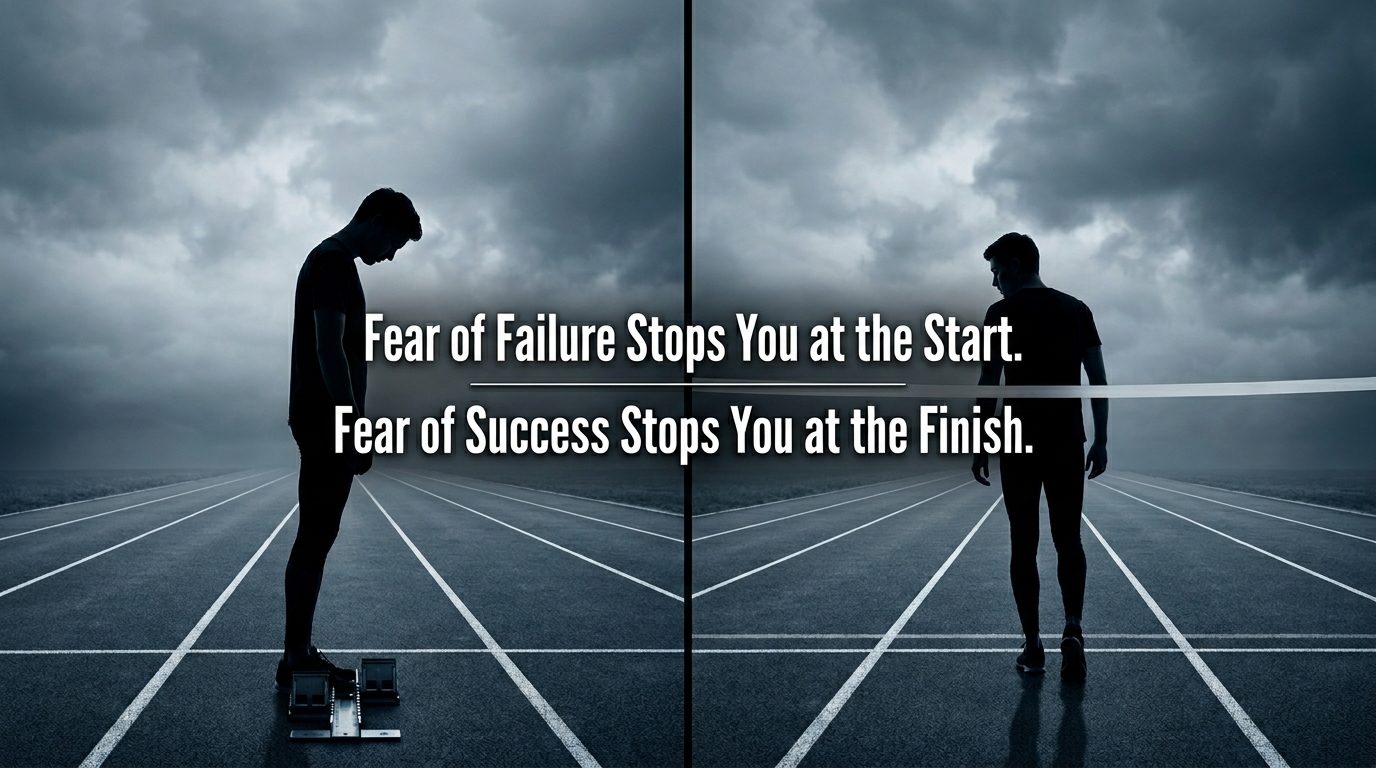
Fear of failure keeps you from starting. Fear of success keeps you from finishing.
The fix starts with naming which one is running you right now. Not both. Just identify the dominant one. Write it down. Say it out loud. That single act of naming it pulls it out of your subconscious and into your control layer.
You are not afraid of losing. You are afraid of what winning will demand from you.
Read more “Mindset Development” articles.
Being Consistent, Why Your Routine Works for a Week Then Falls Apart.
How Does Your Identity Keep You Stuck ?
Your brain does not just want you to survive. It wants you to stay consistent with who it thinks you are.
This is one of the most underestimated drivers of self sabotage. Rishad calls it the identity ceiling. It is the invisible upper limit your sense of self sets for how successful, healthy, loved, or capable you are allowed to be.
If you grew up being told you were not athletic, your body will find ways to quit before you prove that wrong. If you absorbed the message that people like you do not get rich, your spending will spike right when savings grow. If you watched your parents struggle in relationships, you will find ways to recreate that struggle even when yours is going well.
This is not destiny. It is programming. And programs can be rewritten.
The first step is catching the moment you start pulling back. Not judging it. Just catching it. Ask yourself: does this behavior match where I want to go or where I have always been? That gap is your working space.
Identity shifts slowly. You do not fix this overnight. But every time you push through the alarm instead of retreating, you write a new data point into your self-concept. Over time, the ceiling rises.
Your habits are not the problem. Your self-image is. Change that first.
What Role Does the Nervous System Play in Self Sabotage?
Self sabotage is not just psychological. It is physical. Your nervous system is a key player.
Your body goes into a low-grade danger state when stress levels rise close to a high stakes situation. Cortisol rises. Decision-making quality drops. Your brain starts prioritizing short-term safety over long-term gain.
In that state, quitting feels like relief. Avoiding feels like wisdom. Delay feels like strategy.
I have studied this connection between physical stress and self sabotage behavior closely. What I found is that most self sabotage spikes do not come from weak character. They come from an overloaded nervous system that has not been given recovery time.
You push hard. You get close to something real. Your body is exhausted but your mind says keep going. And then your nervous system takes the wheel and finds an exit.
The practical answer here is not to push harder. It is to build deliberate recovery into your approach. Sleep, stillness, and controlled breathing are not soft habits. They are performance tools. They regulate the threat response and give your prefrontal cortex, the decision-making part of your brain, a chance to stay in charge.
When your body feels safe, your behavior aligns with your goals. When your body feels threatened, self sabotage runs the show.
You can eliminate the biological fuel that self-sabotage relies on by controlling your neurological system.
Fear of Failure vs Fear of Success: What Is Actually Driving Your Self Sabotage ?
| Dimension | Fear of Failure | Fear of Success |
|---|---|---|
| When it strikes | Before you begin | Right before you finish |
| How it shows up | Avoidance, excuses, delay | Perfectionism, picking fights, self-destruction |
| What it sounds like | I am not good enough to try | I am not ready yet, even though I am |
| Root belief | I will embarrass myself | I will lose what I have now |
| Common disguise | Procrastination | Burnout or sudden disinterest |
| Who it targets | People afraid of judgment | People afraid of new responsibility |
| The fix | Build courage to start | Build tolerance for a new identity |
Reading this table, most people discover they are running both. But one is usually louder. The one that hits right before the finish line is almost always fear of success. That is the one that drives the deepest self sabotage.
What Are the Most Common Self Sabotage Mistakes People Make ?

Most people try to fix self sabotage with willpower. That is the first and biggest mistake.
Here are the three most damaging mistakes I see, and the direct fix for each.
Mistake 1: Treating self sabotage as a discipline problem.
Most individuals believe that all they need to do is put in more effort. But self sabotage is a nervous system response, not a laziness problem. Increasing pressure without addressing the primary trigger will just cause the pattern to break.
Fix: Stop adding force. Add awareness first. Name the specific fear driving the behavior before you take any action.
Mistake 2:Attempting to alter everything at once.
When someone recognizes their self sabotage pattern, the first instinct is to overhaul everything immediately. That impulse itself triggers the identity alarm and causes a bigger collapse.
Fix: Change one behavior at a time. Pick the single smallest action that moves you forward. Consistency with one thing beats intensity with ten.
Mistake 3: Waiting to feel ready before acting.
The feeling of readiness almost never comes before action. Waiting for it is one of the most common forms of self sabotage because it feels responsible but is actually avoidance.
Fix: Act before you feel ready. Start with a step so small it almost feels pointless. That is the step that breaks the freeze.
Self sabotage does not respond to motivation. It responds to structure.
In reality, how can the cycle of self-sabotage be broken?
Awareness is the entry point. However, it is insufficient on its own.
Here is the framework I use and teach through liveoptimum.com. I call it the Interrupt and Replace method. It has three steps.
Step 1: Catch the trigger moment. Self sabotage always has a setup. A thought pattern, a feeling of being overwhelmed, a moment where you suddenly want to escape. Learn to recognize your specific setup. For some people it is perfectionism. For others it is sudden fatigue or picking fights. Know yours.
Step 2: Name what the self sabotage behavior is protecting you from. Ask one honest question. What am I afraid will happen if I keep going? The answer is usually one of four things: judgment, pressure, failure, or change. Name it specifically.
Step 3: Replace the exit behavior with a micro commitment. Do not try to override the urge with discipline. Instead, shrink the next step so small that your nervous system does not flag it as a threat. Instead of finish the whole project, do write one paragraph. Instead of go to the gym, do put on your shoes. Small actions reset the pattern without triggering the alarm.
Rishad emphasizes this consistently across performance content: the goal is not to eliminate resistance. The goal is to make the next step smaller than the resistance.
Breaking self sabotage is not about strength. It is about strategy.
FAQ’s
-
What are self-sabotaging behaviors?
Self-sabotaging behaviors are actions that block your progress, such as procrastination, perfectionism, quitting early, or avoiding opportunities.
-
Is self-sabotaging a trauma response?
Sometimes. Self-sabotage can be a protective nervous system response developed from past experiences, stress, or perceived threats.
-
What is the root of self-sabotage?
The root is often fear of change, fear of failure, fear of success, or an identity that resists growth and new responsibilities.
-
How do I stop sabotaging myself?
Identify the trigger, name the fear behind it, and replace avoidance with one small action your nervous system can accept.
-
Self-Sabotage book
Books on self-sabotage help identify hidden patterns, but lasting change comes from applying awareness and consistent behavior shifts.
-
What is self-sabotaging relationships
Relationship self-sabotage happens when fear, insecurity, or emotional protection causes conflict, withdrawal, or avoidance of connection.
-
Self sabotage psychology
Psychology views self-sabotage as a conflict between conscious goals and subconscious beliefs designed to maintain familiarity and safety.
-
Self-sabotage or self-sabotage
The correct spelling is “self-sabotage.” It describes behaviors that interfere with your own goals, progress, or success.
-
Self sabotage pronunciation
Self sabotage is pronounced: “self SAB-uh-tahzh.” The emphasis is placed on the second word.
-
How to deal with self sabotage
Build awareness of your patterns, reduce stress overload, and take smaller actions that don’t trigger resistance or avoidance.
-
Why do I self-sabotage when things are going well?
Success creates uncertainty and new expectations. Your brain may see change as a threat and pull you back toward familiarity.
-
Is self-sabotage caused by low confidence?
Sometimes, but identity conflicts and fear of change often drive self-sabotage more than a lack of confidence.
-
Why do I quit right before success?
Many people fear what success will require. As the goal becomes real, avoidance behaviors increase to reduce perceived pressure.
-
Can stress cause self-sabotage?
Yes. An overloaded nervous system prioritizes short-term safety over long-term goals, making avoidance feel like the safer option.
-
Is self-sabotage a discipline problem?
Usually not. Self-sabotage is more often a nervous system and identity issue than a lack of discipline or motivation.

You Can Quit Obstructing Your Own Path.
Self sabotage is one of the most common and most invisible barriers to real success.
Most people never realize they are doing it. They blame bad luck, bad timing, or bad circumstances. But the pattern is almost always internal. When you understand that self sabotage is a nervous system response, not a character flaw, you stop fighting yourself and start working with yourself. That shift alone changes everything.
“In the end, self-sabotage indicates that you are more devoted to your previous identity than to your potential. Change the loyalty and you change the outcome.”
You might also want to read: How Perfectionism Keeps You Stuck Before You Even Start and How to Build a Morning Routine That Actually Survives Real Life.
What is one situation in your life right now where you know you are holding yourself back right before a breakthrough? Drop it in the comments. I read every one.