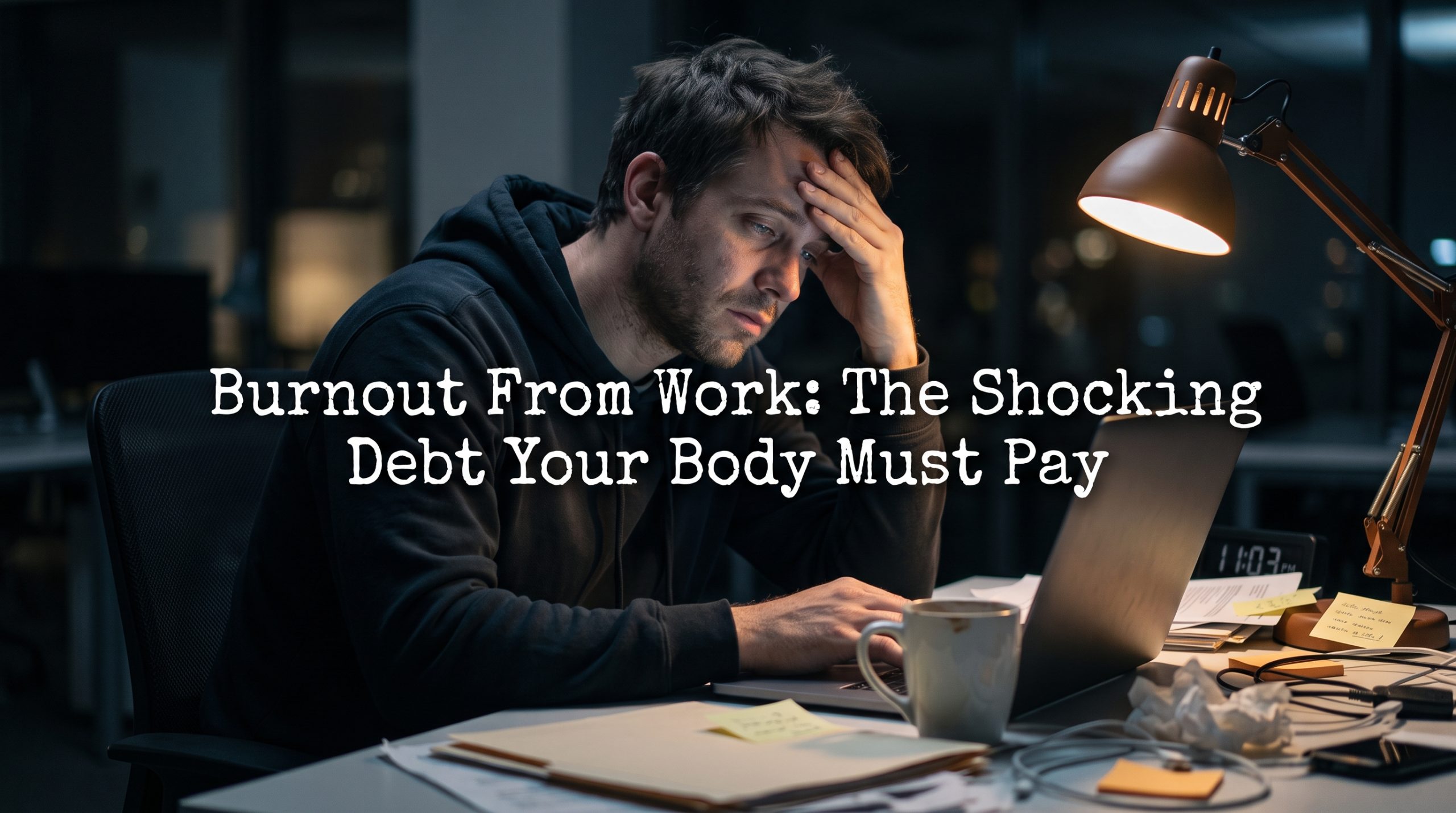
I used to think burnout from work meant I was weak. It doesn’t. It means you built up a recovery debt your body is now forcing you to repay.
Table of Contents
Two years ago I sat in my hotel’s back office at 11 p.m., staring at a spreadsheet I had already checked three times. I was not tired. I was hollowed out.
Burnout from work happens when your body spends more energy on stress than it recovers through rest, for long enough that the shortfall becomes chronic. It is not a mood or a bad week. It is a measurable recovery debt, and it only clears when you pay it back on purpose.
Burnout from work is a state of physical and mental depletion caused by prolonged, unmanaged occupational stress that outpaces your body’s ability to recover. It shows up as exhaustion, cynicism, and a drop in performance that a weekend off does not fix. Health researchers classify it as an occupational phenomenon, not a personal failure.
Key Takeaways.
- Burnout from work is a recovery debt, not a personality flaw.
- Chronic stress without matching recovery is the real root cause.
- A weekend off cannot clear months of accumulated recovery debt.
- Sleep disruption is often the first measurable sign, not the last.
- High performers and perfectionists carry the highest burnout risk.
- Recovery requires structured rest, not just less work.
- Ignored early signs turn burnout into a long-term health cost.
What Burnout From Work Actually Does to Your Body ?

Burnout from work is not just exhaustion. It is your nervous system stuck in a stress response it never got permission to shut off.
- Cortisol stays elevated. Your stress hormone keeps circulating instead of dropping after the workday ends.
- Sleep architecture breaks down. You fall asleep but skip the deep stages that actually restore you. A stronger recovery strategy starts with understanding sleep mindset and recovery rather than treating sleep as simply another task to complete.
- Decision fatigue sets in early. Simple choices, like what to eat, start feeling heavy.
- Immune function drops. You start catching every cold that goes around the office.
- Emotional reactivity spikes. Small annoyances trigger reactions that used to take a lot more.
Most people assume burnout is purely mental, something you can think your way out of. It is not. The mechanism is physiological. Your sympathetic nervous system, the part that handles fight or flight, stays switched on long after the meeting or deadline ends. Learning how to reset your nervous system can provide a practical starting point for downshifting after prolonged stress.
Your parasympathetic system, the one responsible for digestion, deep sleep, and repair, never gets its turn. Over months, that imbalance becomes the baseline, and the debt keeps compounding.
I run a hotel and a construction business at the same time. For eight months I told myself the tightness in my chest during morning site visits was just caffeine. It was not caffeine. It was a nervous system that had not downshifted in weeks, because every gap in my schedule got filled with another decision instead of another breath. The tightness did not go away until I started scheduling recovery the same way I scheduled meetings, as a fixed appointment, not a maybe.
Pull quote: Cortisol from unmanaged work stress can stay elevated for hours after the stressor ends, not minutes.
For practical lifestyle approaches related to stress regulation, see How to Lower Cortisol Naturally.
Why Some People Burn Out and Others Do Not ?

The gap comes down to workload, control, and personality, not toughness.
- Overwhelming workload without support creates chronic strain even in people who love their jobs.
- Low autonomy makes stress worse, because you carry the weight without the ability to change the process.
- Perfectionism pushes people to keep giving past the point where rest should have started.
- Poor role clarity forces constant improvising, which drains far more energy than clear expectations do.
- Weak boundaries between work and rest mean the nervous system never fully exits work mode.
Here is the part most advice skips: two people can work the same hours in the same job, and only one burns out. The difference is rarely willpower. It is usually recovery access. One person has a commute that forces a mental reset, a partner who protects their evenings, or a body that responds well to short naps. The other has none of that, so identical stress produces very different recovery debt.
I used to think ambition was the enemy. It is not. The construction business runs on tight margins and tighter deadlines, and ambition is what keeps it alive. What almost broke me was pairing that ambition with zero recovery infrastructure. Once I built actual recovery into the calendar, the ambition stopped being the problem. The absence of a system to match it had been the problem all along.
Pull quote: Workload alone rarely causes burnout from work. Workload without recovery access almost always does.
The Early Signs You Are Already in Recovery Debt.

The earliest signs are subtle: rest stops working the way it used to.
- You wake up tired even after a full night of sleep.
- Small tasks feel disproportionately hard, like replying to one extra email.
- You no longer feel invested in the work you formerly cared about.
- Physical symptoms appear, including headaches, jaw tension, or stomach issues with no clear cause. learning how to release muscle tension can help address one of the physical manifestations of prolonged stress.
see Burnout Symptoms: What Your Body Tells You First. - Irritability rises over things that would not have bothered you a year ago.
This is the life-pain bridge worth sitting with. Think about a phone that never fully charges anymore, even overnight. You plug it in, you wait, and it still dies by 3 p.m. That is not a broken charger. That is a battery that has taken on damage it cannot recover from with a normal charge cycle. Burnout from work does the same thing to your energy system. Rest stops restoring you at the rate it used to, and that is the signal, not the exception.
I remember the exact week I noticed it. I had slept nine hours and still felt like I had slept four. The frustration of that mismatch, doing everything “right” and getting nothing back, is what finally made me take it seriously. That frustration is data. It is your body telling you the debt is bigger than one good night can repay.
Pull quote: When rest stops restoring you, that is not laziness. That is your recovery system running a deficit.
How to Start Paying Down Burnout From Work This Week.

You start by treating recovery as a scheduled input, not a reward you earn later. Building mindful recovery practices that restore energy can make that recovery block more intentional.
- Protect one non-negotiable recovery block daily, at least 20 minutes with no screens or tasks.
- Fix your sleep window, going to bed and waking at the same time even on weekends. Pair that consistency with physical recovery practices such as recovering your muscles after a workout when training is part of your workload.
- Cut one recurring commitment that drains you and adds little value.
- Move your body daily, even a 15-minute walk, to help discharge stress hormones. For a structured approach to low-intensity movement during recovery, see Active Recovery Workout: 7 Strategic Ways to Reset Fatigue.
- Name the debt out loud to one person, so you are not carrying it alone.
The mistake most people make here is waiting for a slow week to start recovering. That week rarely comes, and even if it does, one slow week cannot undo months of deficit. Recovery works like debt repayment. Small, consistent payments beat one large payment you keep postponing. That principle is also central to recovering faster through sleep, breath, and mind resets.
Twenty minutes of real recovery, done daily, outperforms one long vacation you take once a year.
When I started this at the hotel, I picked the simplest possible entry point: a 20-minute walk before opening the office laptop, no phone, no exceptions. It seemed nearly insignificant. Six weeks in, my sleep had changed, my patience with staff had changed, and the tightness in my chest was gone more days than not. The size of the action was not the point. The consistency was.
Pull quote: Twenty minutes of daily recovery, done consistently, outperforms one large break taken once a year.
Preventing Burnout From Work Before It Restarts.

Prevention means building recovery into your role, not just your routine.
- Set a hard stop time for work communication, and defend it.
- Delegate one task this month that only you currently do.
- Track your energy weekly, not just your task list, to catch early drops.
- Build in a real day off, one with no work contact at all, every week.
- Revisit your workload quarterly, since roles quietly expand if no one checks.
Prevention fails most often because people treat it as a one-time fix instead of an ongoing check. You solve burnout from work once, feel better, and slowly let the same conditions creep back in. The unpopular truth is that avoiding burnout permanently is not realistic for anyone running something demanding. What is realistic is catching the debt early, every time, before it compounds again.
Running two businesses at once means I will always live closer to the edge of overload than someone with one steady job. I stopped trying to eliminate that edge. Instead, I built a weekly check where I ask myself one honest question: does my energy match my workload right now? That single question has caught three near-relapses in the past year, each one before it became a real problem again.
Pull quote: You will not eliminate work stress permanently. You can catch the recovery debt before it compounds again.
The Recovery Debt Loop.
The Recovery Debt Loop is the pattern behind every case of burnout from work: stress spends energy faster than rest replaces it, and the gap accumulates silently until the body forces a shutdown.
It works because your nervous system operates like a ledger, not a switch. Every stressor is a withdrawal. Every real recovery period, deep sleep, movement, unstructured downtime, is a deposit. When withdrawals consistently outpace deposits, the balance goes negative, and negative balances show up as fatigue, illness, and detachment, not as a single dramatic event.
To apply it, start by tracking your withdrawals honestly for one week, noticing every source of chronic stress rather than just the obvious ones. A stress management journal can help you identify recurring triggers and turn vague stress into something you can actually track.
Then schedule your deposits with the same seriousness you give client calls, treating a 20-minute walk or a fixed sleep window as unmovable. Finally, review your balance weekly instead of waiting for a crisis, adjusting workload or recovery the moment the ledger tips negative again.
Quick Comparison.
| State | Body Signal | Recovery Cost | Time to Reverse |
|---|---|---|---|
| Normal Work Stress | Tired after a hard day, refreshed by morning | Low, one good night’s sleep clears it | 1 day |
| Early Recovery Debt | Tired despite sleep, small tasks feel heavy | Moderate, needs 1 to 2 weeks of consistent recovery | 2 to 3 weeks |
| Full Burnout From Work | Chronic exhaustion, detachment, physical symptoms | High, requires structured daily recovery over months | 3 to 6 months |
| Post Burnout Recovery Phase | Energy returning but fragile under new stress | Ongoing, relapse risk stays high without monitoring | 6 to 12 months |
Common Mistakes People Make With Burnout From Work.
Mistake: Waiting for a vacation to fix months of accumulated stress.
Fix: Build small daily recovery blocks instead of relying on one large break.
Mistake: Treating burnout as purely mental and trying to think your way out of it.
Fix: Address the physical mechanism first, starting with sleep and movement.
Mistake: Hiding the struggle to appear capable at work.
Fix: Name the recovery debt to one trusted person to reduce the isolation that worsens it.
Mistake: Returning to full workload immediately after feeling slightly better.
Fix: Reintroduce workload gradually, since early relapse risk stays high for months.
Mistake: Assuming burnout only happens to people who work too many hours.
Fix: Recognize that low control and poor recovery access cause it just as often as long hours.
Final Summary.
- Burnout from work is a recovery debt your body tracks and eventually collects.
- The mechanism is physiological, driven by stuck stress hormones, not just mindset.
- Two people under identical workload can have very different recovery access.
- Small, daily recovery deposits outperform one large break taken occasionally.
- Prevention is an ongoing weekly check, not a fix you complete once.
- Naming the debt to someone else reduces the isolation that makes it worse.
Ending.
Stop asking whether you are weak for feeling this way. Start asking whether your recovery has kept pace with what you are carrying. Most people running something demanding already know the answer.
Written by Bippy (Md. Rishad Hasan Bippy), founder of liveoptimum.com and creator of the Recovery Debt Loop, writing on physical and mental performance development through personal experience.
FAQ’S
-
What is the 42% rule for burnout?
There is no established 42% burnout rule in this article. Burnout is better understood as a recovery debt caused by prolonged stress exceeding recovery.
-
What are the common symptoms of professional burnout?
Common symptoms include persistent exhaustion, cynicism, poor concentration, irritability, sleep disruption, physical tension, and declining work performance.
-
How do I deal with work burnout?
Start with daily recovery: protect 20 minutes without screens, stabilize sleep, cut one draining commitment, move daily, and gradually reduce the workload causing the debt.
-
How long does it take to recover from a job burnout?
Recovery varies. The article estimates early recovery debt may take weeks, while full work burnout can require structured recovery over several months.
-
What causes burnout from work?
Burnout develops when prolonged work stress consistently exceeds recovery. Heavy workload, low control, perfectionism, unclear roles, and weak boundaries can increase the debt.
-
How do you know if you have burnout from work?
A key warning sign is feeling exhausted despite adequate sleep. Detachment, irritability, headaches, sleep problems, and difficulty with simple tasks can also signal burnout.
-
Can burnout from work cause physical symptoms?
Yes. Work burnout can appear physically as persistent fatigue, headaches, muscle tension, stomach problems, sleep disruption, and more frequent illness.
-
Can you recover from burnout by sleeping more?
Sleep is important, but it may not be enough. Recovery also requires reducing the stress causing the debt and scheduling consistent periods of genuine recovery.
-
Can a vacation cure burnout?
A vacation may provide temporary relief, but it rarely clears months of recovery debt alone. Lasting recovery requires changing the workload and recovery pattern.
-
What does burnout from work do to your body?
Prolonged occupational stress can keep the stress response activated, disrupt sleep, increase fatigue, impair concentration, and contribute to physical tension and illness.
-
What is the difference between stress and burnout?
Normal work stress usually improves with rest. Burnout develops when prolonged stress creates a recovery deficit, causing persistent exhaustion, detachment, and reduced effectiveness.
-
Can burnout make you tired even after sleeping?
Yes. When recovery debt has accumulated, a full night’s sleep may not restore energy completely because the underlying workload and stress remain unchanged.
-
How can I prevent burnout from work?
Set work boundaries, protect a weekly day off, schedule daily recovery, delegate tasks, monitor energy weekly, and review your workload before recovery debt compounds.
-
Does burnout only happen from working too many hours?
No. Burnout is not caused only by long hours. Low control, poor recovery access, perfectionism, unclear roles, and weak work-life boundaries can also contribute.
-
How do you recover from burnout from work?
Treat recovery like debt repayment: reduce ongoing stress, protect daily recovery, fix your sleep window, move regularly, and gradually rebuild workload instead of returning to full capacity immediately.